In good company

“Nature does nothing in vain.” – Thomas Aquinas

It is a welcome visitor to our little woodland patch who doesn’t call wildflowers weeds and sees beauty in brush piles.
IMG_2439

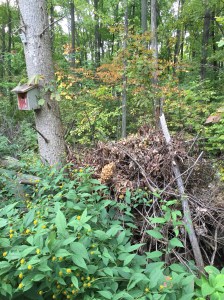
One of several brush piles that shelter birds and other wildlife.

When such a person stops by as one did recently, I smile in silent gratitude for his or her appreciation of a setting that is friendly to birds and other living things, even though it lacks the carefully cultivated, meticulously planned look of the suburban gardens I so admire.

For years, after looking at more orderly yards and gardens, I would return home with tinges of regret that my place paled in comparison to the visions of manicured loveliness I had just seen

But mostly now, those feelings are infrequent and easily forgotten when I hear a Wood Thrush singing in the spring or watch bats swooping overhead on a summer evening. Even in the fall, with leaves tumbling down as a reminder that winter will soon set in, there are delights to savor in migrating birds and the restful sounds of the earth settling down at the end of a busy growing season.

Each day, I am reminded that much of what we enjoy was here long before my husband and I began preparing to live in this spot nearly 14 years ago. From the beginning, we saw ourselves as interlopers more than conquerors and were determined to minimize our intrusion as much as possible.

Still, on the November day we ventured in, carrying colored string and spray paint to mark trees that would have to be felled, I still remember feeling anxious and not a little sad. Even though we were moderate in our choices for cutting – probably too much so for the sake of what would be built later – I felt like an invader.

Pictures from a week later when the big machines arrived show me smiling. I suppose by then, I had resigned myself to the idea of what we were doing. I’d like to think remembering that sense of incursion, though, kept us both in check as we began to develop the site by adding a small barn, house, and trails through the woods. Always, we kept in mind what had been here when we arrived, a pattern that has continued to this day.
P1040334

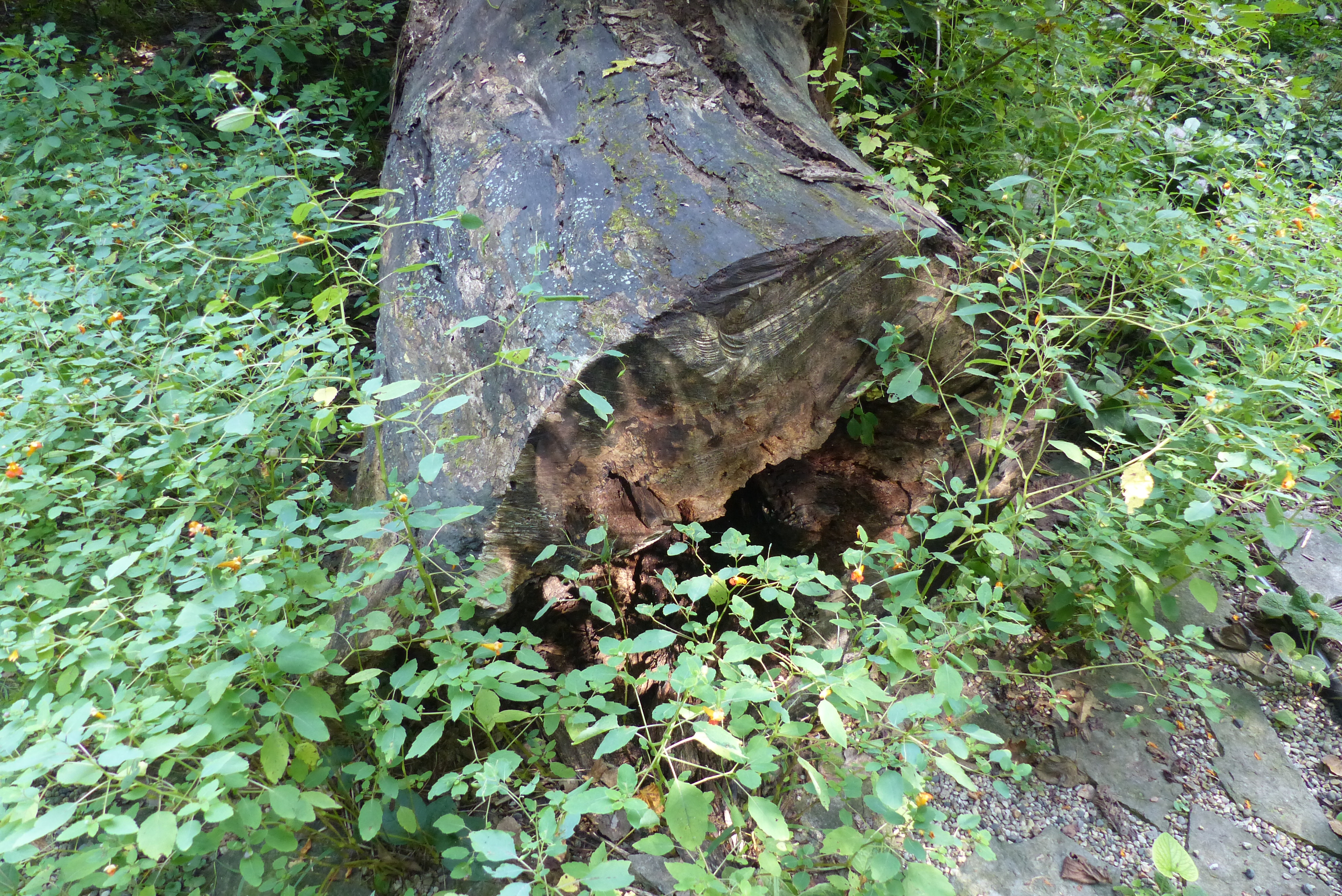
Jewelweed allowed to grow around a fallen log.

Even as we occasionally fall victim to the prolific poison ivy around us, swat at mosquitoes, and encounter the digging habits of chipmunks and squirrels, we have resisted most interventions that would eliminate what some might consider nuisances. Our brush piles, built up with fallen tree limbs and providing shelter for wildlife, are just one testament to this. Another is our choice to relocate piles of fallen leaves rather than burn or bag them as refuse.

Elsewhere, as I make an early spring effort to pull innumerable starts of native Jewelweed out of some areas, I let them grow in other spots, remembering that the hummingbirds will be enjoying nectar from their orange flowers in late summer.

IMG_2434

This sprig of Joe Pye weed popped up late in the summer between some stones.

When I notice foliage being gnawed by who-knows-what insect, I take some comfort in thinking of the culprit as food for a bird, frog, or toad, satisfied that I haven’t poisoned or repelled an avian or amphibian friend with an arsenal of gardening chemicals. Likewise, milkweed, the bane of our farmer friends, is allowed some space because it is a host plant for the Monarch butterfly.

And when I find salvia, coneflowers, and Joe Pye weed growing in cracks between the flagstone and popping up in places I know I didn’t plant them, I think fondly of the birds who are most likely responsible for adding such lovely, random diversity – and more food sources – to our landscape. It is good to know, too, as our recent visitor reminded me, that birders and others share our passion for an environment that is friendly to living things besides humans.

Most importantly, though, I cherish the serenity that comes from living in harmony and partnership with the creatures and plants of a place that predates me and from recognizing and cooperating with its great design in the mind of the One who conceived it.

From emptiness, fullness of joy

The Phoebe nest is empty and its occupants have moved off into the trees, leaving the garden to wrens and hummingbirds.

P1030614

A House Wren pauses briefly in the garden.

In relocating their fledged chicks to a place with more cover, the Phoebes have lifted a curtain on our surroundings, revealing activity we had barely noticed during their frenzied feeding phase.

Suddenly, it seems, we are hearing and seeing afresh the chatter and flitting of House Wrens and the movements of Ruby-throated Hummingbirds, both of which seem to have claimed the territory formerly ruled by the Phoebes.

P1030694

A Ruby-throated Hummingbird over the Bee Balm.

Now, instead of watching the aerial feats of flycatchers, our eyes are trained on the hummingbirds feeding on Bee Balm and Salvia and the wrens busily tending their young in an assortment of dwellings.

We are appreciating anew the songs of cardinals and robins, the bold whistle of the Great-crested Flycatcher, the varied sounds of the Tufted Titmouse, and the simple notes of the Black-capped Chickadee, all occasionally punctuated by a Phoebe crying “FEE-bee, FEE-bee.”

P1030642

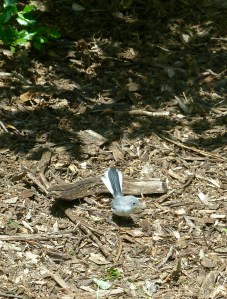
We last saw a Blue-Gray Gnatcatcher during the spring migration, so were quite pleased when this one showed up under the summer sun.

We have been on the lookout, too, for birds that seemed scarce, likely because they were having their young, and now are reappearing more frequently closer to the house. Downy, Hairy, Red-bellied, and Red-headed woodpeckers and Northern Flickers have shown themselves again along with a Red-eyed Vireo and Blue-Gray Gnatcatcher we had seen earlier in the season.

As in life, it seems the absence of something we had become accustomed to seeing has given us fresh eyes and ears for other things we might not have noticed in our midst, or had taken for granted. Just as the departure of a high-achieving first-born can open our hearts to the quiet beauty of a younger child who has been living in an older sibling’s shadow, so changes in our landscape have the potential to enrich our awareness and appreciation of what is around us.

When we allow change to show us what is present instead of what is missing, we hear and see things that may have been obscured or drowned out by our focus on the very thing we had cherished. Just so, if we can bear to be quiet and brush away the distractions that drive our culture, perhaps we can open ourselves to receiving that which is given only in stillness.

P1030604

One of the last photos taken of the Phoebe chicks before their departure from the nest.

The Phoebe chicks, by the way, fledged on July 10. They were in the nest when I left that morning and gone when I returned in the afternoon. The day before, we managed to snap a few last photos of them in the nest. For days afterward, we saw nothing more than one adult, but my husband has since discovered them in an area of pine trees on the edge of the woods.

With a change of season approaching, we know it won’t be long before they will be moving on, along with the other migratory birds who have been with us in the spring and summer. When they leave, another curtain will be pulled back on a garden fading into fall, revealing a new landscape. May we look on it with eyes that are open to seeing its gifts instead of longing for what is passing.

Phoebe summer

It has been more than two months since I wrote about the return of Eastern Phoebes to a nest on our house, and amid the busyness of spring and summer, I’ve been remiss in not reporting what transpired.

P1030332

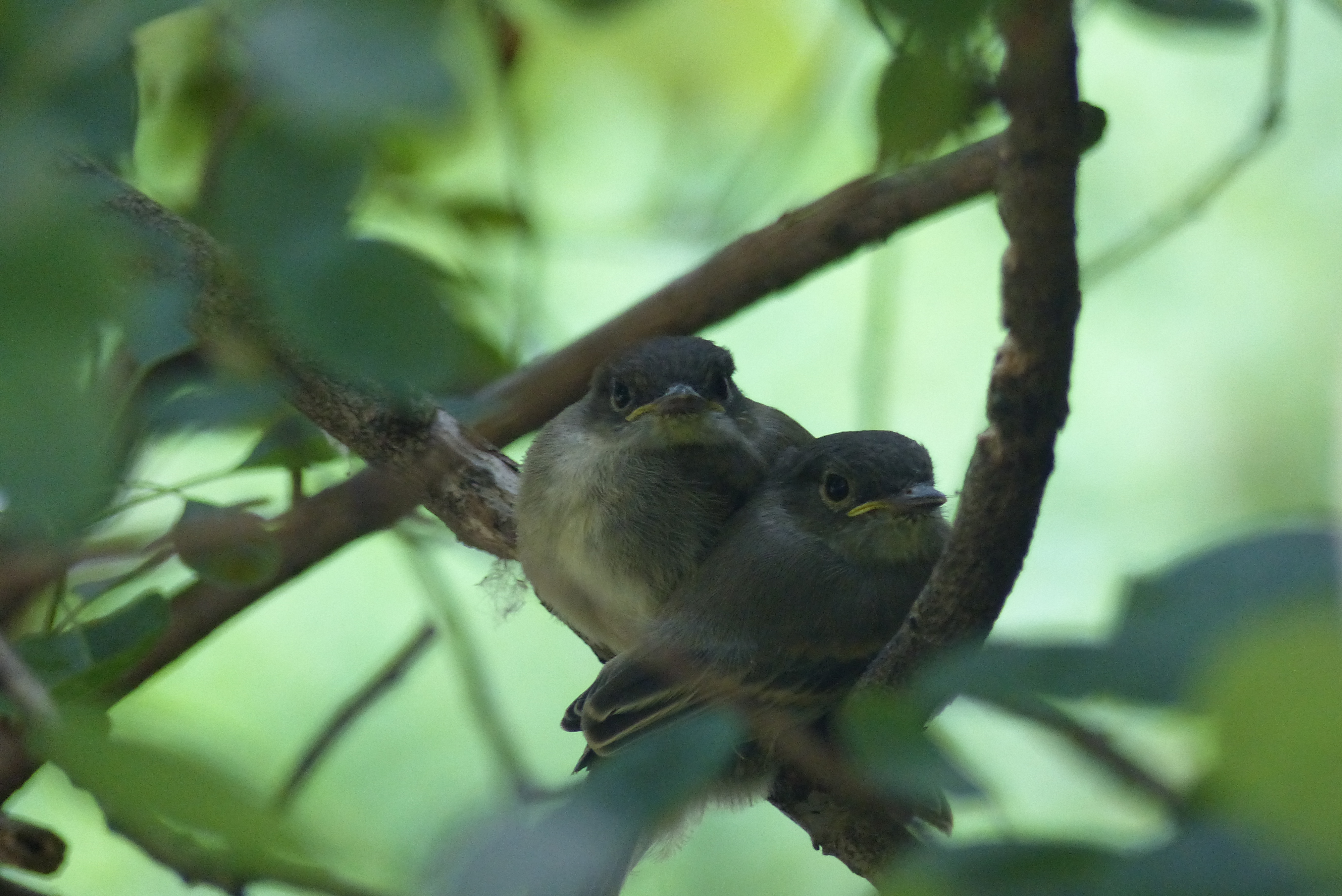
These two chicks stayed in the tree near the nest long enough for us to snap their photo on May 29.

I’m pleased to say that we are having another Phoebe summer, just like the ones we had enjoyed before the last few seasons when these favorite birds arrived on schedule, but did not produce families. In May, the nest on the stone façade of the house just under the soffit yielded two chicks, who lingered long enough after fledging to allow me to snap their photo on the 29th.

Even better, as of this writing, the adults are feeding another family of what looks to be at least three chicks. For several weeks now, the parents have been sallying between garden and nest, snatching bugs and ferrying them back to gaping beaks. Those days appear to be numbered, however. In just the last week, the bulging mass of beaks and feathers we had been observing is now a clearly defined family that is outgrowing the nest and will soon be urged to depart.

P1030496

The porch railing post has been a favorite stopping-off point for the adults before they take food to the nest.

That rite of passage always is tinged with sadness for us because we know we won’t be seeing these beloved birds as often, but the days leading to it are pure delight. Throughout the day and in the evening, we love watching the adults fly into the garden, perch on branches, arbors, and posts, stop by the bird bath, or use the porch railing as a segue between their little nursery and the food supply. As they move about, they seem to become accustomed to our presence, allowing us to train the camera lens on them or weed and water the garden while they are in it, provided we keep a respectable distance.

Before the last few chick-less seasons and after several consecutive years of Phoebe summers, we had come to take the presence of these charming flycatchers for granted. This year, having experienced drought, we are reveling in the joy of abundance, enjoying every sighting of a drab brown-and-white Phoebe, whether we are walking outside, sitting on the screened porch, or peering through the kitchen window.

P1030592

Time to leave? This shot taken on July 7 clearly shows the chicks are outgrowing the nest.

We are hardly the first to discover that Phoebes make companionable and beneficial seasonal guests. In Birds of America, a treasured early 20th-century book we keep alongside our Sibley Guide to Birds, George Gladden writes, “ . . . the [Eastern Phoebe’s] confiding ways and gentle manners have won the real affection of its human neighbors, who should realize as well that it is very useful as a destroyer of noxious insects.” Gladden also praises the Phoebe’s skill and speed in pursuing its prey and provides this apt description of its movements: “Like its relatives it generally selects a perch on a dead limb or fencepost whence it has an unobstructed view of the immediate surroundings, and it is likely to return to this perch after each darting sally.”

Lest anyone even think of discouraging these migrants when they build their nests near human habitations, he writes: “Let the Phoebe remain just where it is. Let it occupy the orchard, the garden, the dooryard, and build its nest in the barn, the carriage house, or the shed. It pays ample rent for its accommodations.”

I couldn’t agree more. From its insistent call in the spring to its aerial feats, bobbing tail, and appetite for pesky insects, the Phoebe brings us many gifts, not the least of which is the window it opens into a world designed to work all things to the good.

Faith, hope, and Phoebes

It’s little more than a cluster of mud, moss, and twigs, but to me, it is cause for joy, and not a little excitement.

P1020631

This year’s Phoebe outside my office window.

An Eastern Phoebe nest has been affixed to the stone on the front of our house under a soffit for several years now, serving as a marker of spring when it is visited by the brown-and-white flycatchers and refurbished for a new brood.

This year, the first Phoebe arrived the week before last and since has been insistently calling “FEE-bee! FEE-bee!” in the morning, afternoon, and evening, sometimes stopping outside my office window to bob his tail and announce his presence. One morning last week, another flash of brown revealed he has a mate and that she is shoring up the remains of the old nest. We can already see the evidence of this in the fresh mud, moss, and bits of vine she has applied as she ferries material from the pond and the garden to the nest.

P1020671

Nest-refurbishing in progress.

Our hope, of course, is that these industrious little birds who have worked their way into our hearts will succeed in raising a family like those we have seen in past years — though not the last two. The year before last, we suspect that a predator bird ravaged the nest and sent the Phoebes fleeing. Later, they began building new nests in two alternate locations, finishing one that still sits atop a post on our wood-storage unit, but despite some nest-sitting, no little Phoebes ever emerged from it.

Last year, the Phoebes again abandoned the nest on the house, this time early in the breeding season after a Brown-headed Cowbird had been seen nearby. Cowbirds lay their eggs in other birds’ nests and leave them to raise their young to the detriment of the host bird’s own offspring. Although we saw the Phoebes occasionally later in the season, there was no sign that they had established another home nearby.

fledges 002

Time to fledge. Phoebe chicks getting too big for the nest in June, 2012.

After several consecutive years of watching these delightful birds raise their families, we had almost come to expect that we would spend our summer evenings on the front porch watching the adults swoop down in the garden to catch insects and fly them back to the waiting mouths of their chicks. While working outside and passing by the site, we also had become accustomed to the sight of little heads popping up and their bodies growing to the point that they were practically spilling out of the nest as the day of departure approached. One year, after the chicks fledged, and thanks to my husband’s keen eye, we even were able to spy the entire family in the woods through our binoculars and spotting scope.

Although the Phoebe is not a “pretty bird” like the Northern Flickers and Red-headed Woodpeckers who frequent our woods or the colorful warblers who pass through during the spring migration, its dogged, no-nonsense habits have endeared it to us. And for the privilege of being in its company, we are more than happy to provide it with an environment abounding in the insects that comprise its diet

In her enchanting book, Letters from Eden, Julie Zickefoose, who is so fond of this bird that she named her daughter Phoebe, writes that to her, the Phoebe “embodies bird spirit” in its constant motion and charm. I heartily concur and would add that underneath the Phoebe’s unadorned appearance seems to beat the heart of an indefatigable warrior with perseverance in its veins.  For that, we love these birds in the same way we love people who have little in the way of looks or sparkle to offer the world, but whose virtue most likely is keeping everything around us intact.

In this, they remind us of faith that is unseen yet is the assurance of things hoped for. So it is that each spring, the Phoebe beckons us to believe in possibilities and to watch for their fulfillment.

The best of the birds:  A post about spring birds is a great opportunity to include a plug for the Biggest Week in American Birding, which takes place May 8-17 in northwest Ohio. If you can get to this area, known as the “warbler capital of the world,” next month, you will not only see some amazing birds showing off their spring colors, but you will meet some wonderful people. 


Loving the least of spring’s gifts

In the swampy region where I live, spring doesn’t exactly arrive on the doorstep with a bouquet of daffodils. More precisely, it announces itself with a sump-pump alarm going off in the middle of the night, in adjustments to toilet-flushing, showering, and laundry routines, and, in general, the presence of mud and water outside.

P1020533While those who reside on higher, dryer ground seize the first mild day marking the end of winter to enjoy a walk or a trip to the park, we rural swamp dwellers laser in on what the spring thaw is doing to our drainage systems. We monitor sumps, septic systems, and fields, and hope for a favorable wind direction and a return to normalcy.

This is not to say that we miss spring’s kinder side. In fact, I think we may enjoy the smallest, most humble harbingers of the season more fully than others do its splendor. Just as my religious tradition’s Lenten practices of fasting, almsgiving, and prayer cleanse the senses so that we hear and see more clearly, so a little bit of water-related discomfort and deprivation goes a long way toward enhancing our appreciation of the least of the season’s gifts.

A friend’s email informing me that her snowdrops, which in the past have bloomed as early as January, finally had opened gave me a surge of joy, as did the sight in my own garden of a patch of lemon thyme that had survived the winter. P1020544I felt the same excitement in discovering dianthus foliage, still surrounded by snow, and a spray of leaves at the base of the rue plant that last summer had been a host for Giant Swallowtail caterpillars.

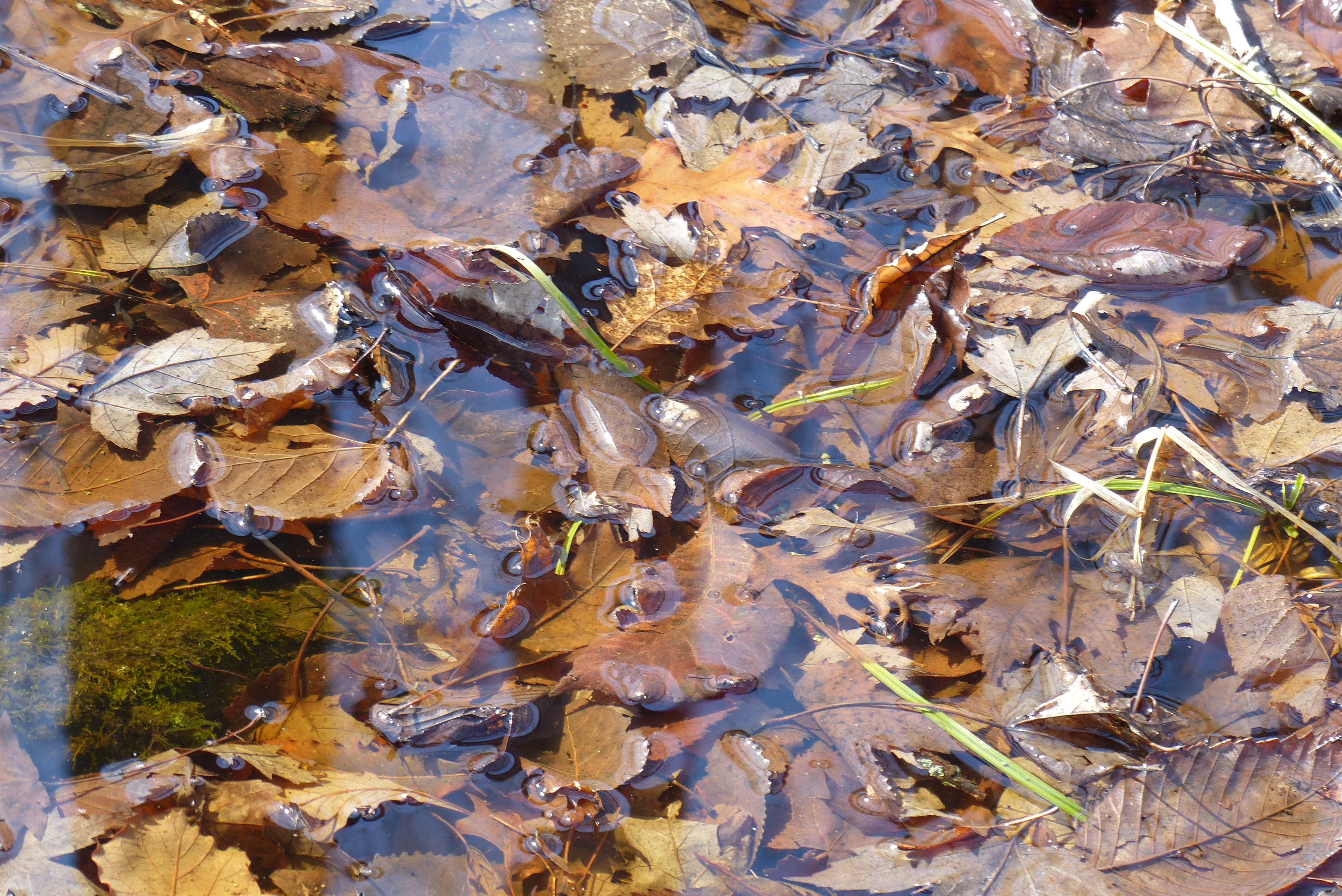
Although little else was growing amid the matted remnants of last year’s garden, I could delight in observing the state of transition everything was in – the melting snow receding to reveal moss-covered paths and clusters of leaves P1020554under water looking as if they had been arranged beneath glass. In other places, trees reflecting on the standing water formed a striking backdrop for the sounds of blackbirds announcing their return, adding their voices to those of the nuthatches and black-capped chickadees who have been here all winter.

These scenes, stripped as they were of the lushness we witness in late spring and summer, nonetheless contained a kernel of hope that something unseen was in the air and about to materialize.

Those of us for whom spring intersects with the 40 days of Lent experience something similar as we use this time of year to detach ourselves from that to which we have become attached. In the decluttering of our souls, we gaze at a barren landscape and sense what has been hidden from us in our hurriedness and preoccupation with doing and achieving. We begin to hear, taste, see, and know that something is coming – and that it will be good.

Lessons in solitude from Jane Austen

. . . It required a long application of solitude and reflection to recover her.” — From Persuasion by Jane Austen.

One of the things I have noticed and come to appreciate about some of Jane Austen’s best-known characters is their habit of taking time alone to think about things. After unsettling encounters with other people, intriguing letters, and jarring experiences, they recognize the need for personal space to sort out their feelings and thoughts.P1010295

Some of them never discuss these matters with another soul – especially when bound by a promise of confidence – but in the course of “solitude and reflection” they review the details and determine how they will respond, what they will convey to others by their behavior, and the significance of what has been said or done.

While re-reading a few of my favorite Austen novels this winter, it has struck me that this practice might be useful in a world that urges us to tell all – and to do so now. What if, instead of rushing to the phone or computer to announce anything and everything, we applied a bit of solitude and reflection to the matters at hand?

When Austen’s characters do that, they benefit in bounds. In Pride and Prejudice, no one was closer to Elizabeth Bennet than her beloved sister, Jane. But though she wishes Jane were with her, she is alone when she receives Mr. Darcy’s letter after refusing his offer of marriage. Left to read and ponder his words on her own, Elizabeth realizes that she was wrong in her prejudice against the man she rejected. She may have reached the same conclusion in an email exchange or conversation with Jane, but the point is that something happened in her silent reflection. Without another’s voice or opinion to soothe or advise, she came face-to-face with herself.

Reflection like that takes time – time that stretches out on long walks or in extended periods of sitting without a phone to tap or earbuds to adjust. It is found in the “be still” admonition of the Bible that ends with “and know that I am God,” suggesting there is something or Someone we cannot know unless and until we are still and removed from human interaction.

With so many ready ways to contact others in our technologically rich society, it can be difficult to resist the impulse to reach for a communications device when we are upset, troubled, or confused. And even if we pause to reflect alone, we may grow impatienIMG_1702t and feel like we are wasting time when an answer, resolution, or insight doesn’t emerge as quickly as we would like.

Sometimes, we have to trust in the process to do its work, and provide us with healing, clarity, or just a time of rest that gives us the strength to carry on.

In Elizabeth Gaskell’s North and South. Margaret Hale sits “long hours upon the beach” after a series of traumas that include the loss of a dear friend and both her parents. Those who pass by wonder what she finds to look at and her family worries about her silence at dinner. Yet, Gaskell tells us, her time by the sea helped her see things in perspective. “She was soothed without knowing how or why.”

When we pause to sit, whether before an altar or by the water, or take a long walk without the filter of another’s thoughts, things have a way of putting themselves right, if only we can be still enough to wait.

‘Tis the season to be . . . quiet

While everyone seems to be pulling Christmas ornaments out of storage, hanging wreaths, and stringing lights outside, I am following my own holiday tradition by resisting the impulse to join them.

In the weeks leading up to Christmas, my seasonal decoration of choice is a simple arrangement of evergreens and candles that will remain on the dining room table until just bP1010437efore Dec. 25.

I understand completely the desire to drive out the dark by infusing our surroundings with Christmas cheer as soon as the Thanksgiving dishes are done. This year especially, when our region has had an early blast of winter weather well before the solstice, it has been tempting to try to shake off the specter of increasingly shorter days with a liberal application of light and color.

But I am choosing again to experience the stillness and darkness of the season leading up to the holiday by holding off on the big decorating and engaging in a time of quiet waiting.

In delaying some of the gratification of Christmas, I am following the practice observed by my mother and father, who likely learned it from their immigrant Eastern European parents. As a child anxious for Christmas and living in a world that jump-started the holiday earlier each year, I didn’t necessarily like that we put up our Christmas tree later than everyone else. As an adult, however, I have come to see the wisdom in waiting, difficult as that can be while the Christmas whirlwind swirls around me and threatens to sweep me into its vortex.

It helps in all this to have the support of a spiritual tradition that observes the season of Advent, which means an arrival or coming. During it, we light one candle, then two, then three, and finally four, on the Sundays leading up to Christmas as we mark the time and think about what – and whom – we await. Our scripture readings for this period talk about being on watch, something we know we cannot do if we are distracted and busy. They also urge us to do some interior house-cleaning, sweeping out the dust of old thought patterns and clearing the clutter of corrosive habits. Stopping to light a candle, pray, and reflect week by week, it seems, slows down the pre-Christmas rush, refreshes our spirits, and helps us turn our eyes away from the material aspects of the holiday, making room for its deeper meaning.

So, even as I buy gifts, write cards, bake, plan food for Christmas gatherings, and try to meet that last writing deadline before Dec. 25, I have a template to follow, a kind of rule that keeps calling me back to where I want to be, in and out of this festive season. It’s not that I don’t get rattled or overwhelmed by all the things that must be done in this busiest of times, but I have a visual reminder – my simple Advent wreath – that summons me to a place of peace and invites me to linger there to consider what is really important and what matters most.

Sweet sounds of the harvest

The chill of the approaching winter has begun to move in, but the harvesting of the farm fields around us still goes on, as it does every fall. Even with snow flurries in the forecast and the TV meteorologists telling us we are having December weather in November, the hum of farm machinery traversing the surrounding fields is in the air.

For me, it is one of the sweetest sounds of the season. That might seem odd coming from someone who writes about and values quiet, but during the harvest, a churning combine is less a noise that intrudes on the peace of our rural setting and more a sound that evokes pleasant associations.P1000738

When the soybean crop – or wheat or corn – is taken off our little plot of land, not only do we happily anticipate the possibility of extra income, but we are reminded of even greater gifts: the land that connects us to family and the big-hearted people who work it for us.

Since moving 10 years ago onto acreage that has been in my husband’s family for a few generations, we often have recalled with appreciation those who lived here before we did without the conveniences we enjoy. We also have known – in bounds – the generosity of our farmer neighbors.P1000744 Besides planting and harvesting our field in spring and fall, they have moved snow for us in the winter and helped us fell dead trees during other seasons. In the summer and beyond, their garden has provided us with everything from beets to zucchini, not to mention the jams and other canned goods that come from their kitchen. Even when we try to reciprocate with a bottle of wine or a box of pears, it’s impossible to return home without a jar of preserves or a head of cabbage.

During our sojourn here, we also have looked to these neighbors for advice about water management, septic systems, wells, and weather – especially snowstorms. They still laugh with us over the night we thought we were keeping up with a significant storm by plowing continuously, a strategy that created barriers of snow on either side of our lane and got us stuck twice. When they heard our midnight tale of woe the next morning and headed over with bigger equipment to knock down the snow walls, all they said was “You should have called!”

Since then, we have had many other opportunities to stand in awe of what they do and the ease with they seem to handle rural life. For them, it’s all in a day’s work, but for us, it’s an art – and something to be admired.

As I snapped photos of their combine making its way through the field a few weeks ago, I was captivated by the sight of the hulking machine stirring up dustP1000734 as it cut, winnowed, and collected the beans. It struck me that, even in the age of mechanization, farming still has a certain romance about it. Our neighbors may not take to the fields singing songs while they work, as portrayed in the idealized rural TV series, Lark Rise to Candleford, but they face the same elements their forebears did, knowing that at the end of the day, they are at the mercy of weather and wind, and whatever price the market will bear.

This year, I got an even closer look at the harvest than my camera would provide when I was invited aboard the combine for a few passes up and down the field. In the interim, I learned what combines were like when our neighbor was a boy and how when he drove his first one as an adolescent, it was not in an enclosed cab with a radio, but on a tractor exposed to the open air. As I watched the beans he had cut spilling out of a chute P1000763and into the truck that was standing by for a trip to the grain elevator, I sensed the satisfaction he and his son, who now runs the family farming enterprise, must glean from their work.

By the time I disembarked, I had added another dimension to my own connection to the land and gained a renewed appreciation for the people to whom it is both home and livelihood. Because of them and this place, the sounds of the harvest always will be sweet.

Unexpected delights

Just as I had resigned myself to the approach of cold weather by deciding to savor and store up some of summer’s gifts, late fall has brought its own unexpected delights.

Although many people where I live claim autumn as their favorite season because of the rich colors of leaves before they fall from the trees, the crispneIMG_1621ss of the air, and seasonal traditions like pumpkin-carving, it was not these that captured my attention as October unfolded.

Rather, it was a mini-resurgence of summer that displayed itself in a Monarch Butterfly feasting on the clover in our field, an Eastern Phoebe and other migrants stopping by on the way South, and the garden popping with scattered patches of color. Even in late October, I found a few stray Black-eyed Susans, Purple Coneflowers, and Phlox in bloom. Elsewhere, tall spikes of annual Salvia had reseeded themselves from last year’s plantings, taking over where the Daylilies had finished their show.

My response to all this has been a surge of gratitude for these unanticipated gifts, the delight of discovering them, the pure joy they have brought, the brief delay in the onset of winter they represent, and for a few more glimpses of beauty to recall as shortened days and lengthened nights descend upon us.

Amid this has come another unexpected October delight – the arrival at my door of the book One Thousand Gifts by Ann Voskamp. I had read a library copy of this book several years ago and when it appeared again as a birthday gift from my goddaughter, I instantly knew the timing was perfect.

Of course, I could have said, “Oh no, I’ve read this already.” But I would have missed the delight – and gratitude – that came from realizing I loved the idea of having my own copy and that it might just be time to shore up my “attitude of gratitude” by re-reading it. Plus, there was a bonus: The book was accompanied by the One Thousand Gifts Devotional, IMG_1611Voskamp’s companion book of reflections.
A writer friend first introduced me to One Thousand Gifts, which describes how Voskamp forged a “lifestyle of radical gratitude” out of the pain of her family’s loss. Having read and reviewed the book, she suggested our book group read it. Even before we began reading, one of our members had prepared the ground by telling us how she was praying in a new way – by naming 50 and then 100 things for which she was grateful each day. Voskamp’s approach was similar in that she decided to accept a friend’s challenge to create a list of “one thousand gifts.” The list became an antidote to the sorrow that encumbered her and had cast a pall over her family after her little sister was killed in an accident. Ultimately, she discovered that being thankful changed her.

The act of naming what she calls “grace moments,” Voskamp writes, took her beyond the “shopping list variety of prayer” and into the love that was shown her by the Giver of all gifts. In “eucharisteo,” Greek for thanksgiving, she began to be fed and filled and sustained.

So in the midst of this October P1000595of unexpected delights, I am looking toward winter knowing I have a good start on stocking up on the same kind of “food.”  Just like the little chipmunk I captured with my camera a few days ago stuffing his cheeks in preparation for the season of cold and snow, I’m on the look-out for other staples to add to my winter pantry: bits of beauty, joys sprinkled among the sadness of our world, signs of hope, and gratitude for it all.

As Voskamp says so well in her book: “We take the moments as bread and give thanks and the thanks itself becomes bread. The thanks itself nourishes.”

Quieting the noise of news

“… the newspapers fetches you the troubles of everybody all over the world, and keeps you downhearted and dismal most all the time, and it’s such a heavy load for a person.”

Tom Sawyer Abroad

Having worked in the news business, I rarely get my fill of knowing what’s happening in the world, but there are times when it indeed can be “a heavy load.”

These days, I seem to hear more frequently that people are feeling weighed down by the news. Given the content of reports about terrorism and killer viruses, that’s not surprising, but I think it also has to do with the pervasiveness of news in our culture. No longer do we find out what’s happening from a daily newspaper dropped on our doorstep or through a single evening television newscast. Now, thanks to 24-hour cable news and the Internet, we have little time to digest anything we hear and see. A multiplicity of voices constantly beckons, teases, and even demands: “Wait till you hear“ and “You’ve got to see this.”P1000484

Response to this glut of information and imagery seems to take two forms: We can’t get enough or we can’t take it. Some love being continually connected to TV news or the Internet, often to the distress of those who live with them. Others take the opposite view, receiving only a minimum of news, if any, and staying focused on the immediacy of their own lives, either because they have enough bad stuff to deal with on a personal level, or because they want nothing to interfere with their state of blissful oblivion.

Given my own appetite for news and tendency to vacillate between extremes, I’d like to propose a middle ground in hopes of encouraging people to be aware of what’s going on while still maintaining some semblance of peace. After all, it’s true that we can handle only so much, but we also have a responsibility to know what is happening in our world and to respond as we are able.

To stay informed without losing our peace of mind, it’s good to be aware of how news is packaged today and why even a steady diet of it is not only unsettling, but doesn’t necessarily guarantee an accurate or complete view of what’s going on in the world.

First, news is not only omnipresent, but highly visual and presented in a way that bombards us with images, trivia, and sound that often take precedence over substantive content. Before you turn on the TV or look at your computer, remember that you are about to enter a highly stimulating zone in which a discordant multitude of rapidly moving pictures and noise will be competing for your attention. On TV, images will be jousting with voices, music, and the news crawl at the bottom of the screen. On the web, advertisements will pop up in the middle of news stories, forcing you to decide whether you want to shoe shop, keep reading about the Ebola crisis, check out the links in the text, or go to a related story. All this is hardly calming.

News is also coming to us from sources other than news organizations as Twitter, Facebook, and email have become vehicles for sharing news and rumors of the latest political scandal, environmental threat, or constitutional crisis. Most of us could spend hours reading what comes from these alternative sources, especially if we belong to interest groups and have friends who post stories on social media or send them to their email contacts.

So before jumping into the roiling sea of news and information, we need to brace ourselves and think about why we’re going in. Is it stimulation we seek or do we know where we’re going and what we hope to find?

Ask yourself what you really need to know about the place you live and the issues and people you care about and where you can best get that information. Find a few sources you trust and stick to those. If you lean toward a particular point of view, add a source representing the opposition to your mix, for the sake of balance, keeping in mind that no presentation of news is going to be completely objective.

Then, consider before clicking if what you are about to read or view is something you’ve defined as a priority in your life or if you’re about to waste your time on gossip or frivolity.

Remember, too, that even when reading about priority topics, there is a risk of over-consuming. Recently, I was caught up in an email exchange with friends who shared my concern about an international news story. We busily forwarded links to each other as we speculated as to what it all meant. By the end of the day, I was weary, as was one of my friends, who wrote: “I don’t know about you, but I’m getting burned out about this whole thing. I could spend entire days reading and reading all the current news about what’s going on, but I am limiting myself. I find that it does me no good, and often makes me restless and anxious. It’s like the nightly news. Some info is important to know in regard to what is going on, but the rest just gets rehashed.”

When something big is happening, many of us have a tendency to watch and read nonstop. At some point, though, as my friend said, we are hearing little that is new and only recycled opinion and fact. That’s the time to take a break.

As for when to consume news, each person has to find his or her own schedule and establish some limits. At our house, we watch a local TV newscast in the morning long enough to get the weather, knowing that the news content is likely to be short and shallow on substance and long and deep on anchor chatter and the latest from the sports and entertainment worlds. Apart from one cable TV news show we watch weekly, we have pretty much abandoned all but occasional TV news programming and instead read news sites online along with two national newspapers that come to our house. We also try to leave the Internet at least two hours before bedtime.

When the news is disturbing, instead of dwelling on it or fleeing, it can help to take some action. Call a legislator, write a letter to the editor, post a civil comment on a website, donate to a charitable cause, or find a way to share what you deem important with others, perhaps allaying fears and correcting misinformation. People of faith also can pray. As the Trappist monk Thomas Merton, who was very much in tune with the news of his day, wrote in his journal in 1960, “It is simply a time that I must pray intently for the needs of the whole world and not be concerned with other, seemingly ‘more effective’ forms of action. For me, prayer comes first, the other forms of action follow, if they have their place. And they no doubt do to some extent.”*

*From A Year with Thomas Merton: Daily Meditations from His Journals