Peace at an early age

Our journey into silence has begun. Last week as a school, we began to cultivate silence in our Morning Prayer service.

When I read this message from the principal of a local church school, I was admittedly intrigued. That someone would be seeking to foster silence in fidgety young charges seemed a noble undertaking, if not a challenge.

After all, don’t we as a culture deal with the high energy levels of the young by trying to channel them into activity, preferably the sound-inducing kind? Isn’t that why we have roving mascots, big screens, and music and cheers blasting from speakers at family-friendly sporting events? In homes, schools, restaurants, and even libraries, aren’t we supposed to keep kids busy and engaged with sound, animated images, or anything that will occupy them?

P1060534In the classrooms of St. Boniface School in the small rural community of Oak Harbor, Ohio, there is plenty going on to absorb young minds, but principal Millie Greggila also knows that her students require periods of peace. So, while they are learning to tally sums, read and spell words, and master the fundamentals of music or science, they are acquiring the ability to calm themselves and remain quiet.

As part of their religious education, the students at St. Boniface meet in the parish church adjoining their school for prayer each morning. But during the liturgical seasons of Advent and Lent, both of which are times of reflection, Greggila incorporates brief periods of silence. Advent, she says, is an especially good time for this because, with Christmas in the air, the children’s thoughts are everywhere. “It’s Christmas and they’re excited.” Yet, Advent is seen as a time of waiting and during it, Greggila tries to create an atmosphere in which the students can learn to be quiet and find some peace.

A need for peace might strike us as unnecessary in little ones whose angelic faces seem to betray no anxiety, but Greggila knows they have concerns that are as important to them as those shouldered by their parents and teachers. When she asks them to pray out loud for specific needs, for example, she hears their worries about what matters most to them – often their angst about a dog or cat, friends who are absent from school, tests, or parents and grandparents. “I can always tell which ones listen to the news, because they pray for whatever calamity has befallen the world, especially those things that frighten them the most.”

Greggila’s hope is that she can show her students how to still themselves and place their worries in the hands of God.

P1060525

“We talk about how we have the power to slow ourselves down,” she said, adding that it’s easy to forget children don’t necessarily come by this naturally and need to be taught. She tells the students, for instance, that sometimes it is not necessary to talk so that they know to enter and leave the church in silence, and once inside, to remain quiet.

When it is time to pray, Greggila begins by leading the students in several spoken prayers, followed by a reading from the Bible. She then asks them to close their eyes, slow down, and breathe, reflecting in silence on what they’ve heard and thinking about those who might be helped by their prayers. Or, she might suggest that they think about ways they should love or a way in which they have not shown love. She also urges them to mentally place anything that is bothering them on the altar to be given to God. And then she allows the silence to seep in, the quiet to take over.

Because St. Boniface is a grammar school and the children are young, Greggila keeps the periods of silence short, but she sees them as a beginning. “Especially now, kids just don’t get ‘quiet time’ – unless they’re in trouble. Wouldn’t it be wonderful if they could find some peace on their own? It’s really a matter of showing them how.”

Cloisters amid the clamor

When I started this blog in 2014, I was inspired by a friend’s thought to make her life a cloister in a noisy world.

At the time, the image struck me as a purely lovely one, but in the intervening months and years, it has become more than a nice idea. It seems a necessary one.

Our world, I think most would agree, has us all increasingly on edge, in part because of events, but also because of the growing presence of noise both audible and visual. As I have written here before (Rest for the Word Weary, Engaging SilenceThe Habit of Being Quiet), more and more we live surrounded by sounds and images, whether it’s ringing, beeping, buzzing phones, blaring music, vehicular and industrial noise, or glowing screens with mesmerizing messages. Every technological improvement seems to introduce a new sound, picture, or distraction, and still another level of stimulation. This has us all on high alert so that when something truly big happens, we feel frazzled and overwhelmed. Although we sense an underlying commotion and turmoil, the beat goes on and we march to it, unaware of the effect all the “prompts” of contemporary life are having on us.

Even my public radio station, once a haven of rest that provided large blocks of soothing classical music, recently added news breaks to the top of each hour of music in the early hours of the day. I discovered this when, after years of waking to gentle melodies, I started to hear droning voices reading the news. When I inquired about the change, I learned that other listeners liked it. I have since turned the radio alarm off and now awaken to a soft beep.

As former allies like my public radio station succumb to the demand for still more stimulation, it is good to know that others recognize the need to carve out quiet spaces amid the clatter of these times. One of these is Cardinal Robert Sarah, whose book, The Power of Silence: Against the Dictatorship of Noise, is a call to step outside the din and encounter that which is waiting for us if we will only be still.

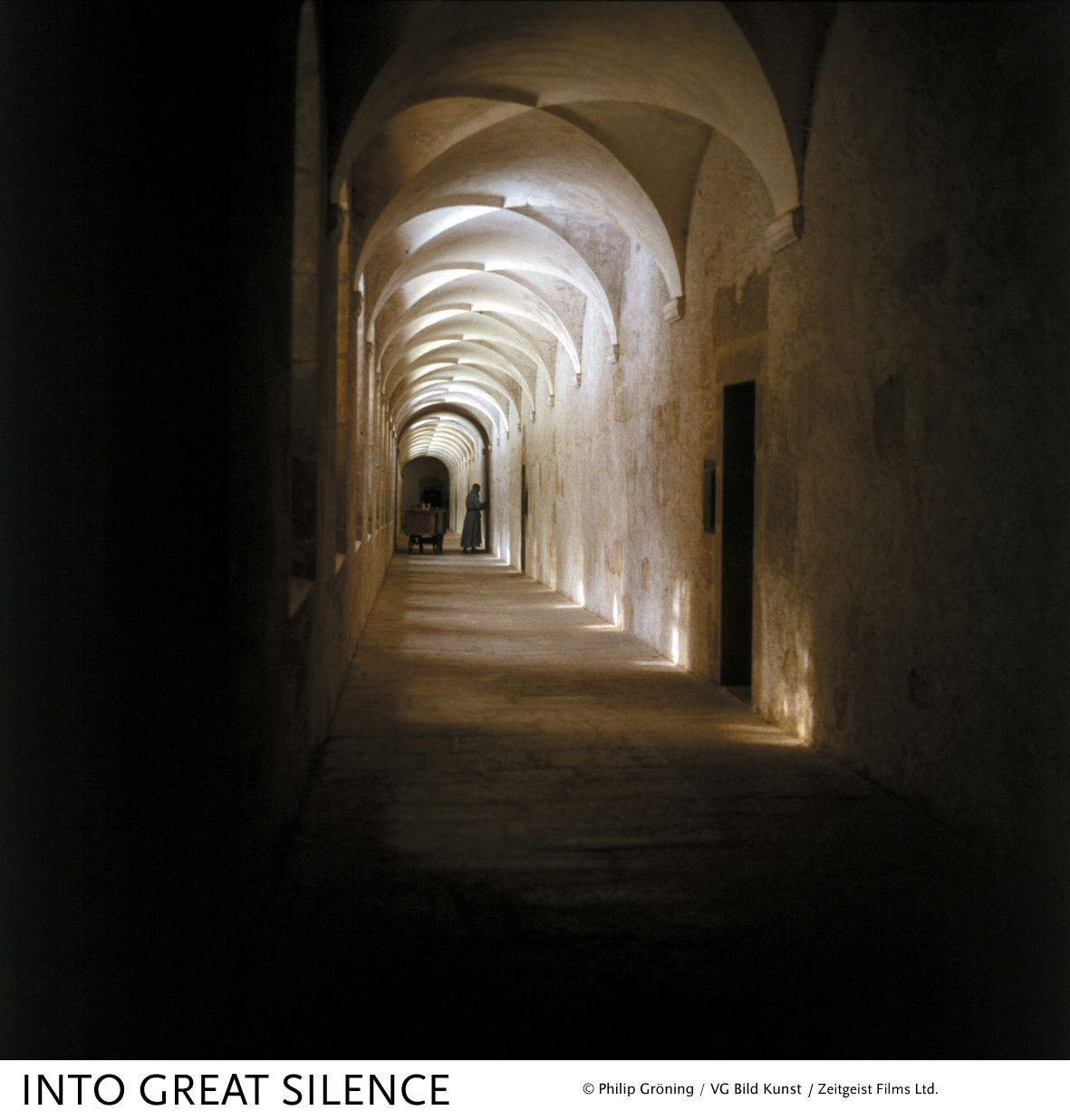
In writing the book, Sarah and his co-author, journalist Nicolas Diat, visited what Sarah called “the most silent place in the Catholic Church” – La Grande Chartreuse, a Carthusian monastery in the French alps and the subject of the 2006 film Into Great Silence. The monks of Chartreuse keep silence on several levels. They do not converse without permission from a superior, spending their days apart from each other and joining their fellow monks only for certain common prayers and worship. They do not watch television or listen to the radio, nor do they read newspapers or the Internet. And of course, they do not carry cell phones. Their silence is intended to help them listen to God, who, as their prior general says, “does not speak loudly,” and to enable them to pray for the world, something they do even in the middle of the night.

Theirs is a demanding way of life and one to which few are called. But they offer us insight into our engagement with the world and perhaps a model for survival amid its raging clamor.

In The Power of Silence, Dom Dysmas de Lassus, the Carthusian prior general, is asked what problems arise from an excess of noise. “If there is an illness that comes from noise,” he responds, “we would have to call it the suffocation syndrome.” He has noticed this in those who come to the monastery for retreats, and in the silence become aware of submerged memories, desires, hurts, and fears. “In their everyday routine, the constant influx of news, meetings, and various activities have ceaselessly covered up these voices in the depths of their being and allowed them no opportunity to re-emerge into consciousness. Silence and solitude reveal them.”

Because such discoveries can be unpleasant, he says, we try to keep them outside our consciousness by maintaining noise, which is easily done in a world filled with information, sounds, and images. In fact, this noise is so pervasive that de Lassus says, shielding ourselves from it requires a kind of spiritual fortitude.

The monks at Chartreuse are protected by their seclusion and their rule of life. For example, the rule provides that only one of them – the prior general – reads the newspaper and in turn informs the rest of important news in their church, country, and the world.

But de Lassus thinks everyone needs some silence and solitude to stay in contact with the heart. Those of us who live in the world, he says, need to find our own “cloister” and our own “rule.”

Years ago, when I first struggled with trying to live a spiritual life in a material world, my late father would tell me, “Jude, you’ve got to live in this world,” emphasizing “live.” He was gently suggesting that because mine was not a call to the cloister, I had to find a balance between the work I did in the highly stimulating – and secular – environment of a newsroom and that which draws monks to a monastery. Today, I hear my father’s words being spoken into an even noisier, more secularized world, challenging me to extract peace from the chaos, make space for silence, and use technology without being used by it.

A woman who lives in a nearby small community recently told me she has no TV in her home and that if she could get rid of her phone she would do so. Although she works and goes to school, she manages to live a quiet and simple life, one that does not require a steady diet of social media or news, most of which she has found to be lacking in substance and significance. Between books and a computer, she maintains her connection to the world, but more importantly, she says, she is renewing her connection to God by learning to sense the divine presence in the stillness she is fostering in her home.

Her example is an inspiring one for those of us who must “live in this world,” but hunger for the peace it cannot give. We cannot all keep the silence and solitude of the Carthusians, but we can expand the presence of both in our lives by facing the unpleasantness of thoughts and fears that emerge in quietude and resisting the urge to cover them with noise. We can choose silence over a radio or Podcast, mute our phones or change their sounds to calming ones. We can read books instead of turning on the TV just to see what’s on.

We cannot escape all news, but we can temper our exposure to it by minimizing the number of sources we consult, choosing ones we can simply read without the interference of sound and moving images. And when we read, we can filter out the useless to focus on the essential.

In so doing, perhaps we can create our own monasteries amid the madness, fostering silence and solitude in a world that desperately needs the peace that comes from both.

When open spaces become dumping places

The “Welcome Birders” signs are up and our little community is ready for an influx of people with binoculars and cameras slung around their necks.

Soon, all eyes will be on the stars of the spring migration – the tiny warblers who stop along Lake Erie’s shores on their way north.

This year, however, birders here for the Biggest Week in American Birding will be seeing a plethora of signs other than those welcoming them. These bright-yellow placards are promoting our community’s effort to stop the dumping of spent lime sludge in a local limestone quarry. Those of us engaged in this David-versus-Goliath fight are hoping to build awareness and elicit additional support from the birding community.

The threat that the quarry dumping poses is something no one in Ottawa County’s Benton Township ever expected to face. Most residents here are occupied with farming, other work, and maintaining their property, even as they enjoy their bucolic location near one of the prime birding spots in the country. Still, because people here are responsible for their own water and sewage via private wells and septic systems, they know what it takes to maintain them. Hence, local conversations of late have been peppered with talk of “the aquifer” that feeds our wells and what effect the dumping of spent lime might have on it, given the sludge contains copper, lead, arsenic, mercury, cadmium and other metals and substances. Lacking a municipal  department that manages our water supply, we have banded together, driven by concern for our wells and a love of the area once known as the Great Black Swamp.

Interestingly, the problem we face involves drinking water in another community – an urban one. The city of Toledo in neighboring Lucas County made national headlines nearly three years ago when toxins from the algae bloom on Lake Erie compromised the city’s water, leading to the temporary shutdown of the municipal water-treatment plant.

To prevent a recurrence, Toledo began making changes that included removing from lined lagoons the spent lime used to clean its drinking water and relocating it elsewhere.  Enter an enterprising company, which bought a quarry in Ottawa County and arranged for one of its affiliates to haul and dump the sludge under terms of a multi-million-dollar contract.

Rural Benton Township must have seemed the ideal setting for this operation. Unlike in the city, the proceedings of the governing trustees are not reported in detail by local news outlets. Also, unlike more densely populated suburban neighborhoods, where people take note of everything from the grass-cutting habits of their neighbors to a for-sale sign going up, rural dwellers are more likely to look out their windows and notice an eagle or Northern Harrier soaring over a fallow field.

So it happened that few of us even realized what was going on at the quarry until last year when the persistent efforts of a neighbor who had observed the activity  and tried to raise the alarm finally captured everyone’s attention.  Since then, residents have organized and educated themselves about what exactly the dumping of spent lime sludge in and around the quarry could mean to these environs and most especially the drinking water.

They’ve learned what the state Environmental Protection Agency can and cannot do, what local zoning laws mean, about other communities that have faced and successfully fought similar threats, and how to get the message out to news organizations. They’ve had signs made and set up a Facebook group and a website that includes a link for donations to help pay the hefty legal bills the township has had to absorb to counter the dumping.

Along the way, people have gotten to know each other a little better, setting aside what differences they might have for a unified effort to protect their water. They’ve discovered that many of their neighbors share an interest in the birds that draw visitors to this area each spring and that they want to do what they can to ensure Benton Township continues to provide a friendly habitat for wildlife as well as people.

In listening to the commentary at township meetings over the last months and interacting with our neighbors, it often has struck me how those of us who live in rural areas value the peace, spaciousness, and proximity to the natural world we find outside the city. Yet, these very qualities make our environs vulnerable to outside forces that would exploit what we treasure. It is a good reminder to all of us to keep watch and stay vigilant, even — and perhaps especially —  in the quiet.

To learn more about the Benton Township quarry dumping, visit http://www.stopquarrydumping.com


On the way of the nothing

“It’s often necessary in life to do nothing, but so few people do it nicely.” – From City of Bells by Elizabeth Goudge

The barrenness of winter has always held a certain appeal for me. Perhaps that’s why, as a northerner, I have little desire to flee to a warmer climate as so many of my peers do at this time of year.

Why that is, I’m not certain, but it may have something to do with relishing the opportunity to do nothing for a season. Not literally doing nothing, of course, but I do love that sense of repose that comes each January after the Christmas rush when we settle in for a long winter of reading, evenings by the fire, and a break from the frenzied activity that foists itself upon us with the onset of milder weather.

These days, as I look out on the stark, gray landscape, I can smile at the cheery messages I receive from friends and family waxing on about the sunny, warm weather and what they are doing in Florida or other snowbird destinations. Deep within, I take a kind of secret delight in being able to stay put and enter into the fallowness of this season and its hidden gifts.

A northern winter forces us into a kind of nothingness that can be maddening. But if we are willing to endure long enough to pass through its portal, we can encounter a place of stillness where we know that under or just ahead of the seeming nothingness lies something precious.

I saw that clearly on a recent weekend when I made my way to Magee Marsh, where I go to watch warblers and other migratory birds each spring. I expected nothing in the way of bird sightings, but merely wanted to walk and experience the landscape in its unadorned winter raiment.

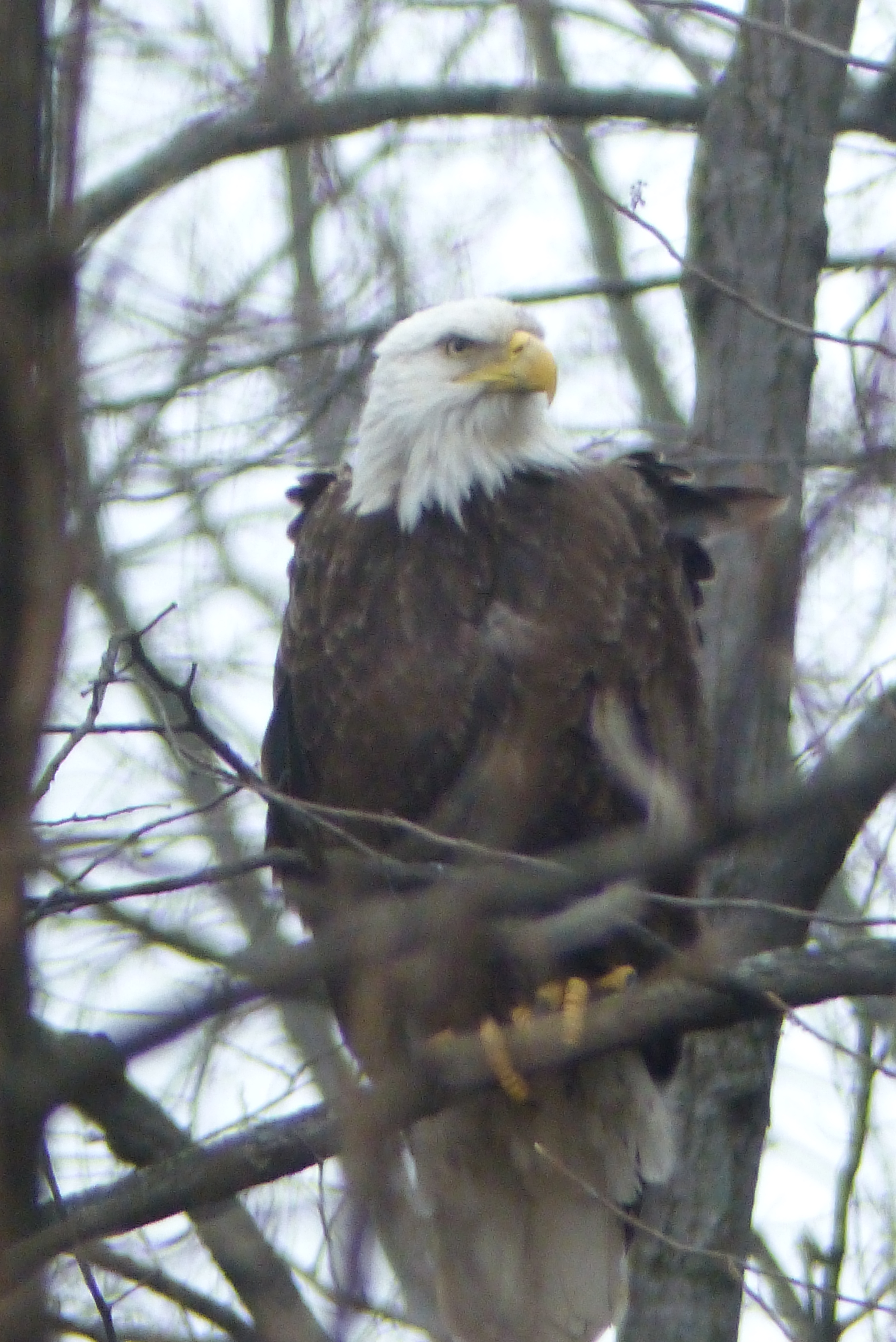
Even so, I was happily surprised by the presence of two Northern Saw-whet Owls that other birders had spied in a stand of pine trees at the marsh’s bird center. Farther in, I was treated to splendid views of a Bald Eagle perched near its nest.

img_3265

Blogger Kim Clair Smith captured this view of a Northern Saw-whet Owl in 2013 and her sighting was just as happily unexpected as mine. Read about it here.

But what has stayed with me most prominently since that day was the incredibly austere setting of the birders’ boardwalk, bereft of any sign of life. As I walked by the places where I have seen Prothonotary Warblers, Baltimore Orioles, Gray Catbirds, Blue-gray Gnatcatchers, Northern Parulas, and Red-eyed Vireos, I was mostly struck by the utter nothingness of my surroundings. Aside from two birders I encountered on the way out, I saw no one and nothing but barren and felled trees. The contrast to what I see in the spring was almost breathtaking. In May, I am elbow-to-elbow with birders and nature photographers walking under leafy branches and straining to see Wilson’s or Orange-crowned warblers.  There is a hum of excitement and activity as birders from around the world converge in groups to train their binoculars, scopes, or cameras on a particularly sought-after bird or share the news of a good sighting “at the loop” or “by the east entrance.” Could this be the same place? Indeed, it was.

img_3262

The Magee Marsh boardwalk in its winter raiment.

That day, I loved the marsh and the boardwalk for their essence, revealed by the absence of foliage, people, and birds. There seemed to be nothing, but there was something. It was much as I had come to love the frail frame of my aging mother before she died because it reflected the graceful serenity that remained as she was taken down to her bare branches.

By detaching from my desire for and memories of spring and facing the nothingness of the landscape, I received something new, as we do in the spiritual life when we abstain or fast from our pleasures so as to hear and see more deeply things eternal.

In the spring, I will love the marsh even more for having seen it in its barren state. But for now, I will treasure the memory of its frame, consoled by its beauty and anticipating the joy of seeing it transformed from its state of seeming nothingness into one teeming with life.


Learning to be

“There are seasons when to be still demands immeasurably higher strength than to act.”              

— Margaret Bottome

As students head back to classes on campuses around the country, I have been thinking about the school our family has been enrolled in for the last few years. It’s one we didn’t choose to attend and the curriculum is a bit erratic.

I call it the School of Being, because it describes what we are learning about one of our family members who has dementia.

Although like most people in our culture, we want to “do” something in the face of any suffering or loss, in this instance we are finding that often our greatest act of kindness is to “be” with Pops.

Sometimes, he requires action: a shave, help in the bathroom, his glasses cleaned, or hearing aid located. But the focus when we visit him in the memory-care unit where he now lives cannot be on these acts. It has to be on him and where he happens to be at the moment.P1000218

Early in this journey with dementia, someone told us, “You have to enter their world.” And so we do.

That usually means a simple and cheerful greeting and then waiting for a signal. Often, we simply pass through the looking glass with him and see what he is seeing, hear what he is hearing, ponder with him what he is thinking. This can involve answering the same question multiple times as if we are responding for the first time. Or, it can mean summoning our imaginations and indulging in flights of fancy and even a bit of nonsensical speech, the kind we use with little children.

Frequently, Pops reveals a kind of idee fixe that sets the tone for our time with him. It could be “Where’s Mom?” meaning his deceased mother or his very-much-alive wife, or maybe both because he’s mixed them up in his head. Or, if we find him just waking up, we might be treated to some spirited, repetitive commentary on how well he had been sleeping.

One day, while seated at a table in the dining room, he lasered in on several chairs in the next room, saying he was going to sit in one. He remained where he was, however, continuing to talk about his plan to get up and relocate. We encouraged him, reviewed the choices of chairs, and which seats were available, all without any action on his part. Finally, the locus moved to a woman who was sitting – and sleeping – in one of the chairs, so we talked about her and the various aspects of her state of slumber. “She’s really snoozing.” “I think she’s catching some flies.” “Yep, she’s out like a light.”

Another day, Pops told me he had been on an airplane the night before. I learned that he and his wife had been separated so that each was on a different plane. “I bet you didn’t like that,” I said, to which he replied, “No, I didn’t!” And so we were off, chatting about this as if it had really happened, because for him, it had. Whatever the source or reason, it didn’t matter. He was where he was and I was right there with him.

At still other times, Pops becomes agitated if there is too much activity around him or if he sees that we are conversing with an aide, another resident, or visitor, and we are reminded once again of the importance of being with him and being present to him.

P1030986So it is that we are all learning new lessons in this school that has no vacation or seasonal breaks. “Being” is not easy to master in our action-oriented, instant-response world, one in which all our minds are racing toward doing something. It requires slowing down, stilling our thoughts, and, in our encounters, trying to sense where the other person is before we speak or act.

For my part, I’m discovering that I’m still too absorbed in a jumble of thoughts when alone and too quick to jump in and share my own opinions, stories, or ideas when with another. Typically, my own experience or state of mind springs to the fore when someone is talking and, instead of listening, I plunge in with advice or a “that’s just like when” comparison. Or worse, I don’t listen at all.

Being with someone whose cognitive functions are compromised is forcing me to stop, look, and listen because I’m clearly on unfamiliar ground and need to find my way.

As a creature of our active and materialistic society, I am learning from someone whose life has been reduced to the essentials that the most important gift I can give is a quiet and receptive presence, one that waits to see where the other person is and then remains there for a while. Sometimes that means saying nothing and just being there, and accepting that it is enough. The late Fulton J. Sheen once said, “The world’s greatest need is . . . someone who will realize that the real worth is achieved not so much by activity, as by silence.” I think Pops would agree.

Growing contentment in the garden

The kiss of the sun for pardon,

The song of the birds for mirth,

One is nearer God’s heart in a garden

Than anywhere else on earth. 

 — Dorothy Frances Gurney (1858 – 1932)

From the time I was a small child growing up in a religion rich with liturgical smells and bells, church had been a place where I experienced a sense of God. There, the scent of incense lingering in the air consoled and the candle that flickered day and night in a red glass lamp served as a soothing sign of the divine presence.

All that was altered, however, with the death of my parents. Church suddenly became a place of sad memories: of pushing my mother’s wheelchair in and then struggling to get her to the basement bathroom mid-service. Or of beginning to notice how gray my father’s skin was looking against that of others beside him as his condition worsened.

IMG_0090

Brunera, top, and Woodland Phlox in bloom.

After my parents died within a year and a half of each other, I wasn’t angry at God, but church was simply not the place of peace it had been for me in other seasons. I continued going there in this extended state of grief and spiritual numbness, knowing that it was important to maintain a connection to my faith at such a time, but I was surprised to find more tangible comfort in a new place: my garden.

I had been something of a gardener since marriage eight years earlier had brought with it an acre of unwieldy property peppered with huge pine trees and assorted nooks and crannies that seemed to be begging for attention. But now, I started to attack the dirt with new energy. One day, I noticed that a gentle peace I had not felt for months would settle upon me as I weeded, dug, and watered.

I began to go back for more. Over time, I would not only sense a comforting presence in the garden, but through the growing cycle, I would glean practical spiritual lessons from tending a troublesome plant or discovering the dangers of admitting invasive varieties into my space.

P1030300

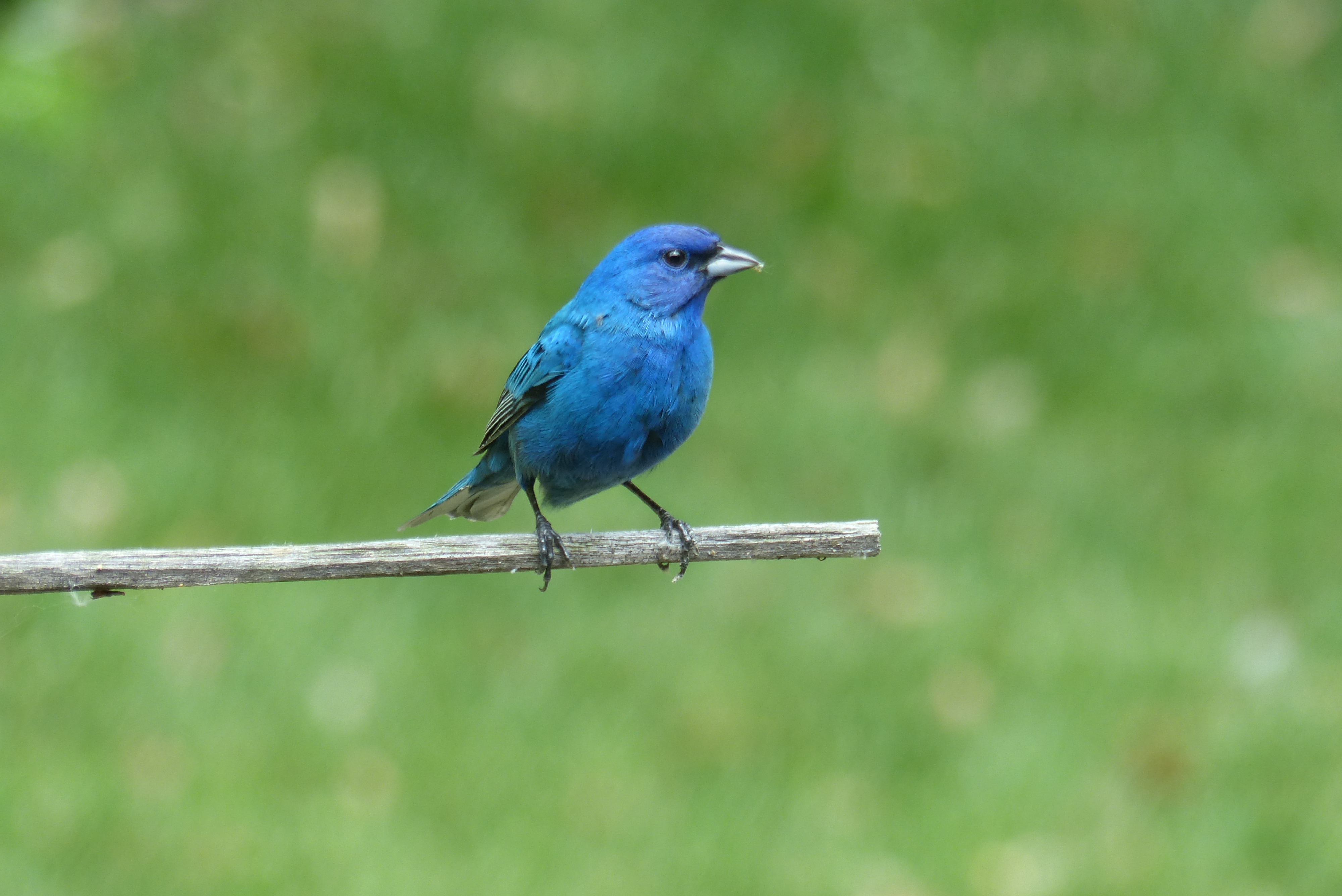
A male Indigo Bunting, known to sing all day.

I eventually recovered a sense of peace while being in church as memories from that difficult period of loss healed. But I have continued to find solace in the garden, as I know many gardeners do. Perhaps it is because the act of working with our hands frees our minds to listen to a voice that speaks in whispers, in “the kiss of the sun” and “song of the birds,” as Dorothy Frances Gurney says so nicely in the above excerpt from her longer poem, “God’s Garden.” I discovered Gurney’s lines on a decorative plaque as I was venturing into gardening and warmed to them immediately. The words come home to me again and again as I take in bird song and bask in the sun, pausing to consider the richness of my surroundings.

I sometimes think of deceased family members who were gardeners – my husband’s Uncle Bill, to whom my patch of Bee Balm stands in silent tribute; my paternal grandmother, who planted snap dragons with her vegetables, and my father, who left me two precious garden tools from his years of growing a small patch of onions, peppers, tomatoes, and garlic, likely as a holdover from the Great Depression. I understand better now what drew all of them to the dirt and why they seemed so contented when they were communing with the growing cycle.

IMG_1411

Bee Balm, introduced to me by my husband’s Uncle Bill and a favorite of hummingbirds.

Although the words Gurney wrote about gardening were inspired by a very proper English garden at Penshurst Place in Kent, and my own garden is decidedly on the wild side, their sentiments speak to me whether I am reflecting on the beauty of things in bloom or cultivating their home.

Recently, a friend who was surveying my garden when it was much in need of a spring cleaning asked, “Do you ever just get to sit and enjoy this, or are you always working on it?” I do have time to rest on the front porch or stroll through and gaze at the fruits of my labors, but I also am much at peace while planting and pulling weeds. There are exceptions, of course, like when I’m being buzzed by a deer fly or mosquito, dig into a colony of ants, or pick the most humid day of the year for mulching. But on most of the grand days of the growing season, those are mere distractions in what to me is still a refuge, a place where I listen and God speaks.


Looking for loveliness

“One can always find something lovely to look at or listen to.” – from Anne of Windy Poplars by Lucy Maud Montgomery.

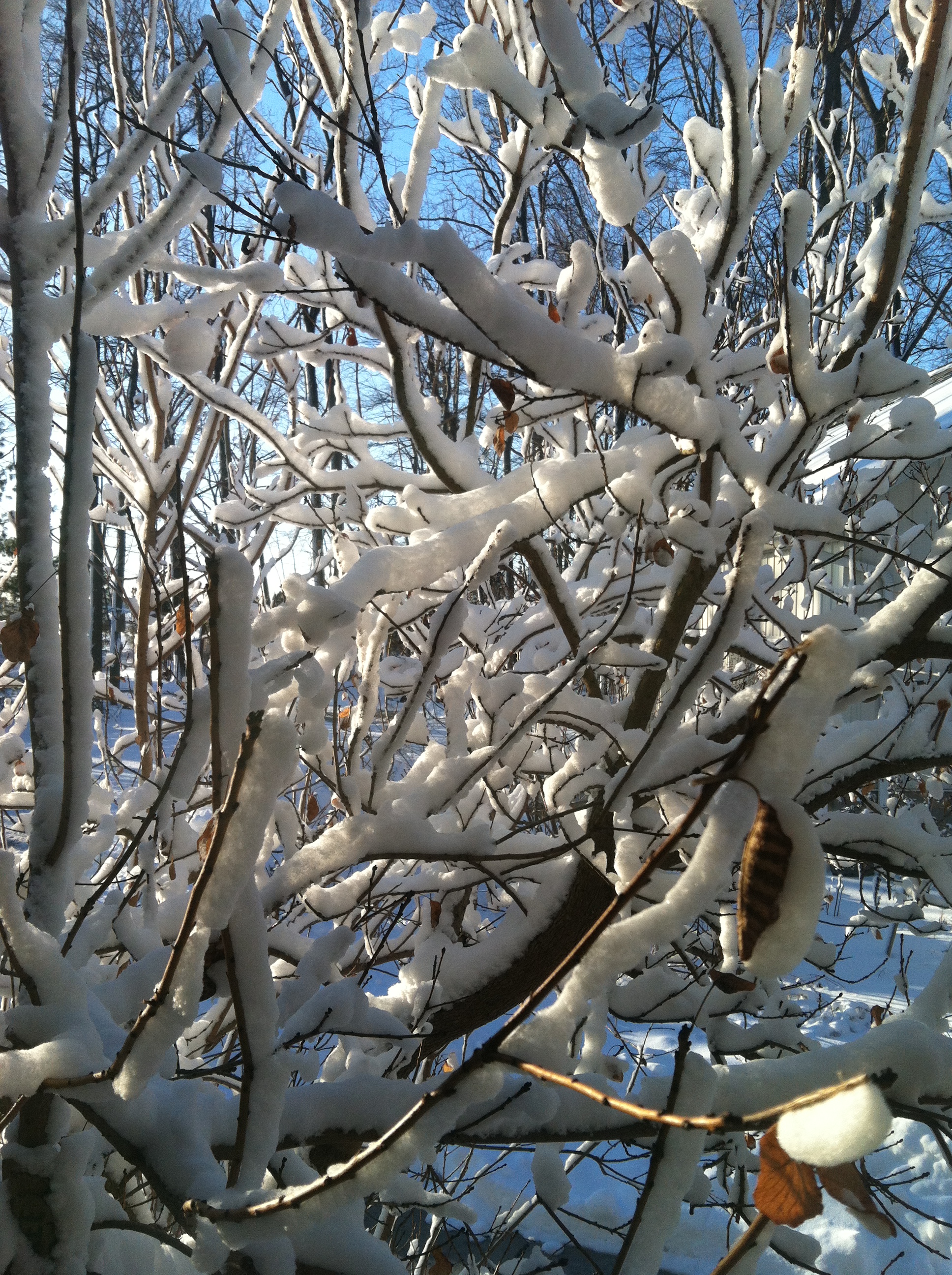
I ran across this line while re-reading some of the Anne of Green Gables novels during the last days of winter and, as I began writing about it, found “something lovely to look at” outside my window. A snowstorm had sheathed the trees in white, turning the barren scene into a wonderland, especially when the sun added a IMG_0972glow. Anne would have been pleased at the sight, though I think she would have gone into greater raptures about it than I have done here.

IMG_2604

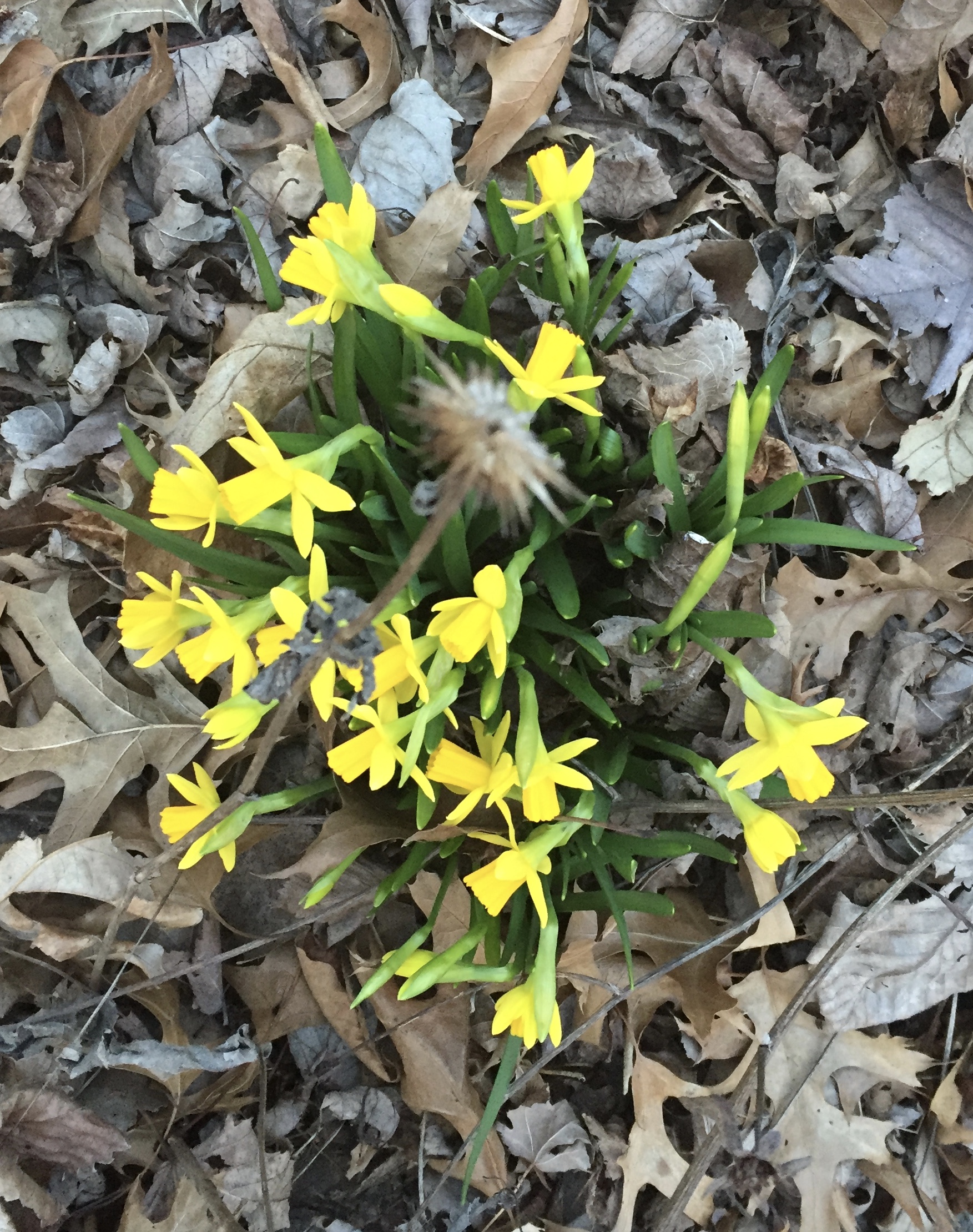
These miniature daffodils are among the first blooms of spring in our garden.

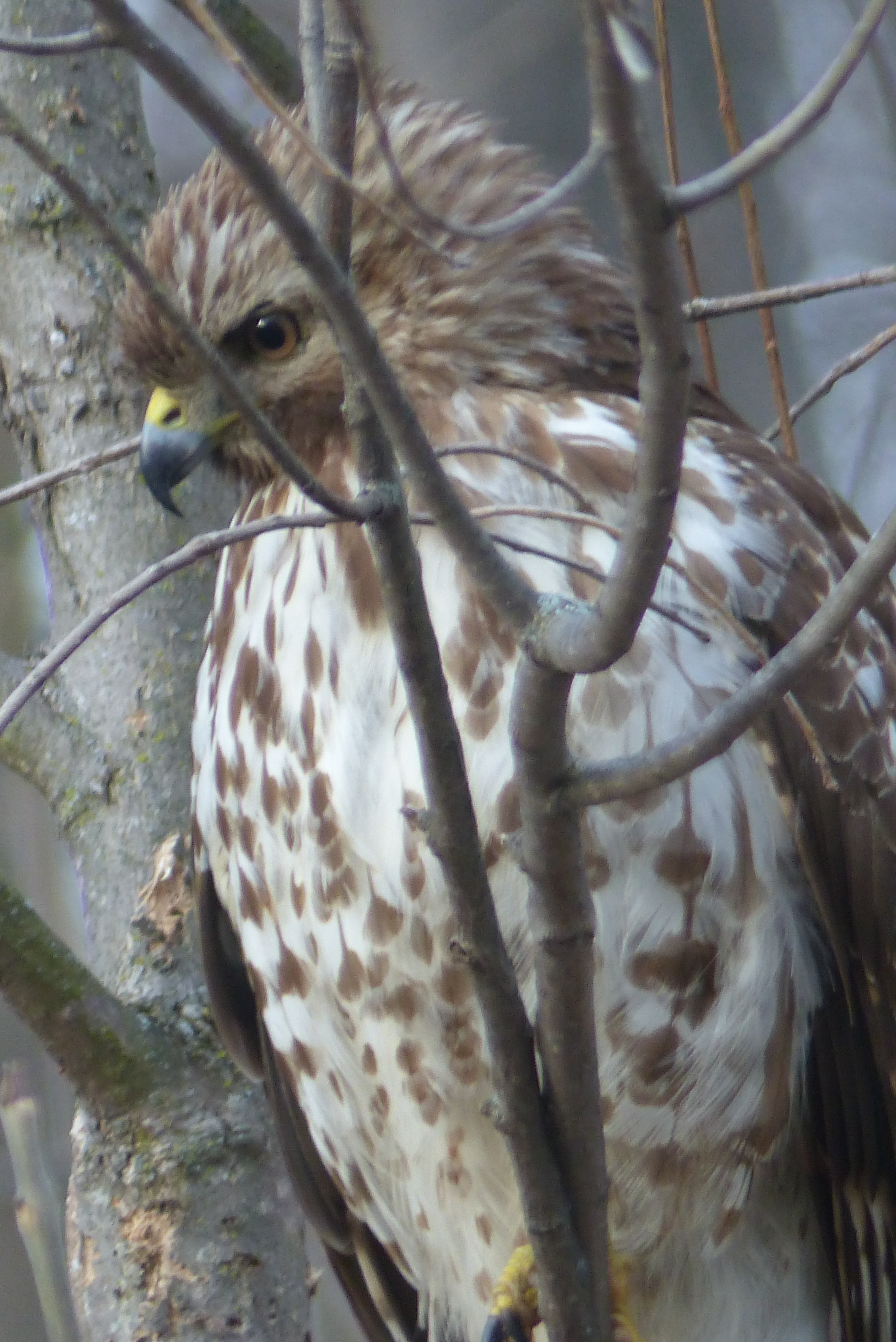
Now, with the approach and finally the onset of spring, it has been much easier to find lovely things to see and hear. The first miniature irises and daffodils have bloomed in the garden, and foliage from other plants is poking through the cover of dead leaves. Our bird population is changing, as evidenced by the chatter of blackbirds, punctuated more recently by the call of an Eastern Phoebe, and sightings of a pair of Fox Sparrows, a cloud of buzzards kettling overhead, and two Eastern Meadowlarks in a field outside the woods. Amid this, a Cooper’s Hawk added to our delights by alighting near the pond and mugging for our camera as he surveyed the property for food.

Such lovely somethings and the joy they bring are the sweet reward for those of us who fully experience the darkness and cold of northern winters. But the lesson of Anne of Green Gables is to find them in all seasons, whether gray or green. Anne’s example and that of others encourages me to be constantly on watch for “something lovely,” and especially to seek it out on days when it seems absent.

My husband, who has a lifelong habit of observing the landscape wherever he happens to be, has been a great teacher in this regard. He learned as a child to scan a horizon, a stand of trees, a seashore, or even a span of power lines for “something out of place,” “something that doesn’t fit.” So it is that he frequently sees Bald Eagles and hawks while working outside, looking through a window, or driving, and is the first to catch the movement of Wood Ducks flying through the trees or a Northern Harrier swooping over a field. In fact, lovely somethings seem to find him, almost as if they hone in on his receptivity.

I am pleased to be the beneficiary of his sightings, and, thanks to his coaching, occasionally have my own, as happened recently when I heard, then spied a flock of swans in the field abutting the lane where I walk.

Frame-22-03-2016-09-49-41

Had I not been alert to the possibility of “something lovely” that day, I might have missed this pleasant scene. Indeed, it was a morning when the shabbiness of a gray, foreboding sky, muddy fields, and the chill of the air conspired to distract me from thinking about anything of beauty.

But living like Anne – and my husband – demands resisting acquiescence to appearances. It requires a willingness to believe that another layer lies beneath what we see and the resolve to delve deeper to find it or to wait for it to be revealed.

P1040860

A visiting Cooper’s Hawk.

When I don’t do this, I miss opportunities, as I did some years ago when I noticed a bearded, elderly priest had joined the ranks of the residents at a home for the aged I sometimes visit. He had a kind of poetic bearing, almost that of a hermit who spent his days in the desert and his nights in a cave. One of the residents told me he was very holy, but it wasn’t until some time after his death that I learned he had been a prolific author and noted figure in certain religious circles. As he lived out his last days in relative obscurity, I had observed him and been intrigued, but apparently not enough to go deeper to discover who he was. Clearly, I overlooked a treasure in my own backyard.

Writer and naturalist Cindy Crosby could easily have done the same when she moved to a seemingly barren Chicago suburb after having lived in settings with more apparent natural beauty. In By Willoway Brook, she tells how, though less than enthused about her new location, she focused on “the landscape at hand,” noting the birds in her backyard and putting up feeders to draw them in. Then she discovered a tallgrass prairie nearby – and in it more birds. Soon, she saw “the possibilities that lie within exterior and interior landscapes” as the prairie became for her a metaphor for prayer as well as the motif for her work and writing.

P1040904

One of the Bald Eagles my husband spied recently.

Still, she learned that not everyone saw as she did. When an acquaintance who had listened to her ecstatic praise of the prairie’s grasses and flowers felt compelled to investigate for himself, he walked away bewildered. “Weeds, Cindy,” he told her. “It’s nothing but weeds.” Had Anne of Green Gables heard his dismissive comment, she likely would have shaken her head and said sadly, as she once did to Marilla Cuthbert, “Oh . . . how much you miss.”

But then for Anne, the stretch of road the locals called “the Avenue” was the White Way of Delight, Barry’s pond was the Lake of Shining Waters, and the spring by the log bridge was the Dryad’s Bubble. In the final Anne novel, Rilla of Ingleside, World War I has cast a shadow over everyday life, but Anne and other “kindred spirits” still keep watch for the lovely, even when sorrow descends. For that, they are the richer, finding the light in the darkness and uncovering the marvelous in the seemingly mundane. For my part, I think I will stick with them, rambling through the seasons, looking for loveliness everywhere, and expecting to find it.


Rest for the word-weary

“Thanks for giving me your email address. I will keep it on file for use in case of an urgent need for correspondence with you, as I consider it best if we stay away from the continuous contact so overwhelming in our digital era.”

Those lines from a letter I received via post last month were balm to a spirit wearied by words. The weeks since I wrote my last blog entry have been filled with myriad duties requiring much oral and written communication, some of which has produced seemingly little fruit for the energy expended. So it was that the message cited above was a welcome one, not only because it recognized the exhausting nature of communication in this age, but also because it was a rare voice of restraint in a milieu where “can” means “do.”

P1040781

Letting the words speak for themselves: Destiny and Decision, Sermon Nuggets, and More Sermon Nuggets, by Fred Zimmerman.

The writer of my letter is Fred Zimmerman, a retired minister and author who has been around long enough to remember a different sort of life than the one to which we all have become sadly accustomed. He uses electronic communication sparingly, as indicated above, and still takes the time to write and send letters on paper. In publishing his books – a memoir and collections of excerpts from his sermons – he employed a similar strategy, deciding to let the words speak for themselves instead of seeking to advance them through interviews and social media posts.

Although some might consider his style anachronistic in our media age, I love its bold, yet gentle, countercultural stance. And I think it explains why he is able to pierce the clutter of words and images inundating us today with his incisive insights.

From his writings, I know that he values solitude as a time to commune with God. Without it, he writes in his second volume of sermon excerpts, “we cannot hope to live a meaningful life and perform meaningful work.” He goes on to quote William Wordsworth: “The world is too much with us . . . getting and spending, we lay waste our powers.”

In our day, the world that is “too much with us” is one peppered with words, images, and opportunities to interact with each another, all vying for attention day and night on our computers and smart phones. Unlike the characters in Jane Austen’s novels who take time to write and read their letters, carefully discerning and reflecting on the meaning of the words, we have no leisure to process our missives. The instant – and insistent – nature of text-messaging and email urges us to read and respond immediately so that sometimes we miss or misinterpret our correspondent’s meaning. Or we get so many messages that some are lost or forgotten as we deal with what seems most urgent.

This has affected us in ways I suspect we do not even realize. Our thoughts and conversations are scattered, and our preoccupations often trivial. Our minds are noisy and crowded, with scarcely any room for or recognition of a profound thought should one float by, and our speech frequently is a sad reflection of this disorder. It is no wonder that many of us seek solace in nature, where we can quietly gaze on birds and sunsets, P1010498for only there can we escape the barrage of words and digital images that constantly bombard us – provided a cell phone doesn’t beep or buzz.

Quite simply, we are talking too much and taking in too much. Although it’s tempting to simply withdraw from the digital world for a time, as some do as a means of fasting during this season of Lent, I prefer my minister friend’s approach of moderation, making use of technology’s gifts without letting them rule our lives.

Other friends have done similarly. Some only answer emails at certain times, rather than whenever they happen to get a message. Another friend removed the Facebook app from her phone so that she does not check it as frequently. One method I use is to mute my phone so that I’m not prompted to look at it every time it announces a text, email, or call.

Although all these are helpful in setting boundaries for interfacing with the electronic world, they are mere steps to something greater and worth pursuing — what the spiritual classic Divine Intimacy calls exterior and interior silence. These do not mean we never speak or think, but that we avoid idle chatter, prolonged conversations, and talkativeness and keep watch over the imagination, feelings, and thoughts in the interest of preserving a state of receptivity to what is most important. The author of Divine Intimacy, Father Gabriel of St. Mary Magdalen, lived from 1893 to 1953, well before the Internet’s entry into our communal space, but his words – and those of my minister friend – are timeless. They speak to every person’s sense of restlessness and yearning for peace, one that is universal, regardless of the times and circumstances in which we live.

Tempering our good tidings

It’s time for that seasonal staple known as the holiday letter, a tradition that, as a recipient, fills me with a mixture of dread and delight.

Although I enjoy reading what people have been up to in the last year and looking at photos of their charming families, I lament the trend toward filling these missives with accomplishments and acquisitions – especially considering that Christmas is about the birth of a babe to poor folk in a humble setting.

With the onset of social media and the expansion of Christmas cards into one-size-fits-all letters, it seems we’ve reached a new level in what used to be decried as bragging. In glorious, illustrated accounts of our good fortune, some of us seize on Christmas as an opportunity to detail trip itineraries, house plans, and job P1040752promotions, all with seemingly little awareness of those on our mailing lists who may be struggling with illness, death, economic hardship, and other woes.

I know that we are to rejoice with those who rejoice and weep with those who weep, but when you’re busy rejoicing in print over your own fortuitous circumstances, can you really hear someone weeping? And, although those who weep are often gracious enough to be glad for the blessings in another’s life, do we need to push them to the limits by going overboard with our good news?

I have also noticed that in letters from some people who have real struggles, their concerns are either barely acknowledged or strangely absent. For example, I got a letter one year in which a short notice of a family member’s passing was sandwiched between triumphant paragraphs about high-achieving children, pets, and a second home. In another instance, I once asked a friend why she wasn’t sharing something of her difficulties with her aging parents in her annual letter and she said she didn’t think people wanted to read that sort of news over the holidays.

But what if leaving such things out gives the impression that our lives are perfect, creating distance between us and those we call friends? Do we really want people to think we lead lives in which the most agonizing decision of the year was whether to buy Viking or Sub-Zero appliances for the new gourmet kitchen, or the most taxing challenge was coordinating flights to multiple destinations so as to maximize air miles? It is good, after all, to know not just the happy occurrences, but the sorrowful ones, too. By this, I don’t mean that we should report every detail of a surgery or send out screeds of anguish, but that we give people an honest, balanced picture of our lives.

As an antidote to some of the excess in holiday letters, I’ve tried different tacks over the years, such as writing short notes in my cards or, if a letter is appropriate, personalizing it and toning down good news, acknowledging losses, and writing about nature. I’ve noted and appreciated those friends who have chosen similar alternatives like sending poems they have written or, as one has done this year, excerpts from a sermon he first preached in December, 1986. For last year’s letter, I simply shared a reflection I had written for the funeral service of my Aunt Anna, who had died just before the holidays. I thought her quiet life had something to teach all of us, especially at this time of year.

My aunt, a woman who lived simply and learned early on that money and things did not buy happiness, seems to be speaking again as we begin another holiday season. Her greatest pleasures, especially in her later years, came from watching deer and birds through the windows of her apartment and eventually, the care facility where she died. As I wrote her funeral reflection, I was inspired by a W.H. Davies poem that seemed to capture her. It begins, “What is this life, if, full of care, we have no time to stand and stare.”

If my Aunt Anna had written a holiday letter, there wouldn’t have been much in it, for she didn’t have a lot to say in social situations. Her life was more about being than having and doing. Theologian Yves Congar writes of letting God brush away “the various ‘havings’ that serve us as alibis and lead us to evade the decisive issues of ‘being.’” Deep within, we all know we avoid what is real by our “havings.” It would be nice if, when we send our holiday greetings this year, we could dispense with our lists of “havings” and convey something of our “being.”

Transfiguration

In the spirit of Thanksgiving, I’m grateful to be able to share this beautiful November reflection as a guest post by Carolyn, a fellow writer whose thoughts formed the July 11, 2014 post, Giving children room to wonder. The photo of the ice-encased crabapples was taken by her oldest son, Francis, whose pictures also were part of the earlier post. 

As I sat on the tractor, in the chill of the frosty November morning, it seemed as if neither the world nor I would ever warm up. But, watching from the edge of the field, I saw a slow transformation begin to unfold. The sun had been making a late appearance on these fall mornings. Now, just in time for my mid-morning break, it was finally rising over the tops of the leafless trees. Meter by meter, the dark, cold field was illuminated, reminding me of a shade being opened in a dim room. The Goldenrod, Joe-Pye, and Ironweed looked a little dull and “seedy,” but as the sunlight kissed them they caught fire. IP1080696 watched in awe and realized that each flower in the field, each stem of grass, was encased in its own very fine layer of icy frost. What had seemed a dead, wet, dull brown field was awakened into a warm palate of late fall color. Cinnamon, umber, ochre, and mahogany shades materialized as I realized that I, too, was beginning to warm up. My eyes hungrily attempted to take everything in before the angle of the sun changed and the magic dissolved. And then, there seemed to be a pause in the stillness as if an artist were taking his breath before painting the final and most difficult part of a scene. The sun reached a copse of crabapple trees. I never saw a diamond that dazzled me as much as each single ice-encased red or yellow crabapple. The light entered the ice at the top of an apple and kindled a halo of liquid fire around each one.

As if attracted to a beacon, a flock of birds alighted in the first tree. The bright red feathers on their wings and yellow-dipped tails seemed to want to find understanding in the clusters of red and yellow berries. But, at the same time, the bold, black mask and flashy crest of the Cedar Waxwings asserted their singularity.

Sitting back in my seat, overwhelmed by emotion, I realized that a corner of my heart had a profound sadness. I wanted to be able to capture the moment in a painting or picture, but would never be able to recreate in any way even a portion of the beauty I had just encountered.

When I sat on the edge of that field, I was 20 years old. My lifelong faith was just beginning to be caught by that transforming fire that turned it into something beautiful and alive. When I experienced the beauty of that field, I sat still and knew that God’s loving hand was touching my face. And I was thankful.

Now almost 20 years later, I look back on the encounter and see many more layers. Each year since then has been an unfolding of some new aspect of the beauty of God’s love. Little by little, the shade has been opened in my darkened room so that I can now begin to see the transformation of the events of my life. Things that would have looked at best, mundane, and at worst, like overwhelming suffering, I can now see as having their own profound beauty.

The sadness I felt on the seat of that tractor is still tangible. I am constantly faced with the depth of my inability to share the beauty of God’s love. But I also live a great hope. I know if I offer him this cold, dull, dark field, he can transform it into something that will reflect the splendor of his love — something even more dazzling than an ice-encased crabapple.