Savoring summer’s gifts

“I gather sun rays for the cold dark winter days.” – from Frederick, by Leo Lionni.

As summer begins to fade, a plaintive refrain of regret can be heard in places where the season of sun and fun never seems long enough. “It’s gone so fast,” we say. “Can you believe summer is almost over?”IMG_1550

The season we love to anticipate does fly by for those of us who live in northern climates and only get a few months of warmth each year. Once we shed our winter layers for shorts, tees, and flip-flops, it is easy to settle in and forget that fall and winter eventually will return. Then somewhere around July 4, we start saying, “Summer is half over. Where did it go?”

Although I am sensing with everyone else the passing of this season of ease, I am greeting this juncture with less regret, thanks to a teacher friend who introduced me to Frederick the field mouse in the children’s story cited above.

Instead of gathering “corn and nuts and wheat and straw” like the other mice, Frederick sits and collects “sun rays for the cold dark winter days.” He stares at a meadow, storing up the colors of flowers, wheat, and leaves. And when he seems to be half asleep and dreaming, he explains, “Oh no, I am gathering words. For the winter days are long and many and we’ll run out of things to say.”

The story ends happily when Frederick comes to the rescue just as his family of mice is out of food and stories. He is ready with his rays of sun and colors that everyone can see “as clearly as if they had been painted in their minds,” and finally, uses his storehouse of words to create an entertaining poem, delighting his fellow mice, who applaud him and proclaim him a poet.

My friend, who would read Frederick to her second-graders, first shared this story with me some years ago during our annual late-summer “beach day.” As we sat on the sand, she suggested that, like Frederick, we could store up sunshine, warm breezes, and a blue sky reflected in the waters of the lake before she would be consigned to a classroom for another school year. It was always a delicious day, one that seemed to prepare us for the onslaught of the winter we knew would follow even the most beautiful fall.

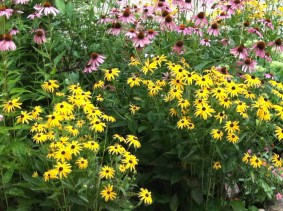
So now, insteIMG_1504ad of gathering regret at the end of each summer, I try to follow Frederick’s lead by savoring and stashing away the best of the season. This year, that has meant spending many an evening on the front porch listening to the birds as they settle in for the night, and then casting my eyes skyward to watch the bats flying sorties at dusk. It has meant taking time to look over my less-than-perfect garden and appreciate its gifts: the Purple Coneflowers and Black-eyed Susans that were and are so stunning this year, the bunches of elderberries on branches that grew from what was a small plant just a few years ago, and the new foliage and blooms that emerged from the bottoms of the dead frames of two beloved bushes I had thought were forever lost.
IMG_1368

I have paused to fix in my memory the sun rising over a bean field as I take my morning walk and the swaths of swamp rose mallows lining the causeway at a nearby wildlife area. I have smiled when startled by the Northern Cardinal’s early-morning wake-up call while it is still dark and been soothed by the whistle of the Eastern Wood-Peewee off in the woods. I have tucked away the treasure of wren chatter and peeping hummingbirds, of Eastern Screech-Owls calling back and forth at nightfall and dawn, of a Great Crested Flycatcher visiting my garden, of a newly fledged Red-Headed Woodpecker at the suet feeder with its parent, and of a splendid Cooper’s Hawk on the edge of our garden pond.

If you have slipped into a kind of sadness at the passing of summer, it’s not too late to do as Frederick did. Soak up some sun, and look, listen, and savor the treasures of this season. They will warm, feed, and delight you – and perhaps those around you – as the days grow shorter. Not only that, but they will drive out regret and remind you that summer is indeed endless when you store up and recall its beauty.
Pockets of peace

Like finding the perfect home, the quest for quiet would seem to be about location. But in our noise-driven world, the peace we try to carve out of the chaos around us often is disturbed by all manner of sound. IMG_1454

Neighborhoods touted by realtors as “quiet” can easily erupt into auditory mayhem, especially on weekends when power tools and lawn equipment emerge from garages. Or, when a new family arrives on the block with two barking dogs and installs an outdoor sound system.  Even rural dwellers learn that not all people move out of the city for the same reason when they discover their neighbor’s idea of country living is having a place to race ATVs, or a winter night’s stillness is broken by the whine of snowmobiles.

So what to do if you are a quiet-seeker dwelling among people who are fond of two-cycle engines and loud music?

Having lived in urban and small-town neighborhoods as well as the country, my husband and I have found that talking with persistent noisemakers does not typically bring about a lasting peace.  First of all, one person’s noise is another’s delightful distraction or good clean fun. For example, a family member who lives near an airport and railroad tracks tells us he loves hearing large planes fly over his house and the rumble of a train in the not-so-far distance.

Because those who create what seems like excessive noise to some of us do not often take kindly to suggestions that they lower the volume, lovers of quiet sometimes have no choice but to leave a noisy place, either permanently, which is not always practical, or temporarily.

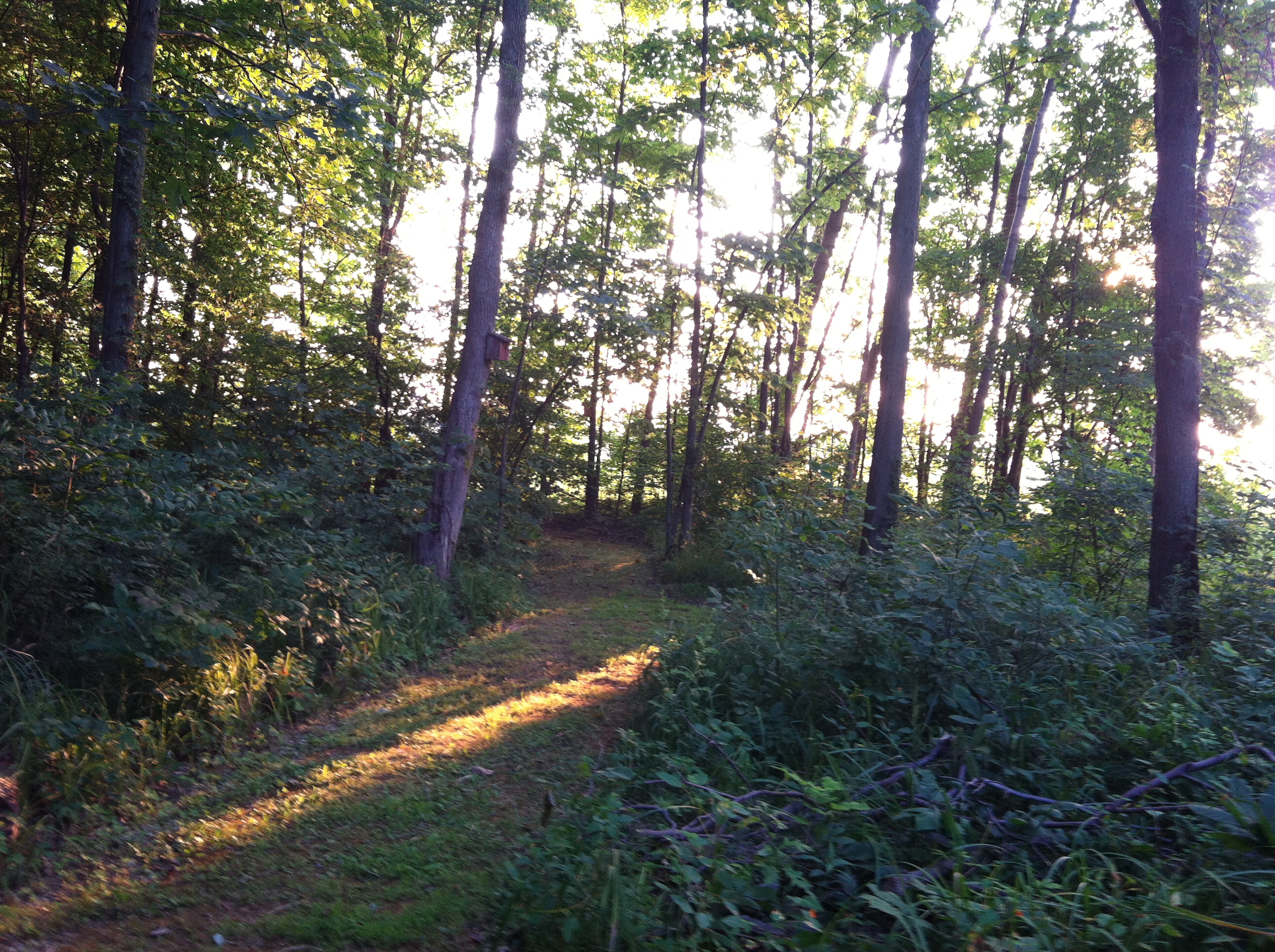
Although I live in what, for the moment at least, is a mostly peaceful setting, I’ve always had quiet escapes. When I was a suburban dweller, my favorite getaway spots inIMG_1353cluded a park with wooded trails, one of which had a stand of pines with an inviting opening that seemed to breathe calm. Another of my escapes was cycling out to an area where I could sit on the sand and listen to the water lapping against the shore. When I worked in a windowless cubicle in a newspaper office, I would sometimes use my breaks to take walks or sit by a fountain in a downtown park. In less pleasant weather, the public library was a ready refuge. Even now, if I am in the midst of a busy schedule of errands and appointments, stopping at an art gallery, a museum, or  a bookstore offers some respite from the rush.

These pockets of peace, I have found, make it possible to endure the noise, whether it’s in a neighborhood, a work environment, or my own mind. If I can slip into one for 15 minutes or an hour, I can return to the madness refreshed and renewed.

This is obviously an imperfect solution, especially for those of us who have created some quiet space in our homes and feel as if we are being driven from it by others’ predilection for noise. Gail, a reader of my recent post on “Engaging Silence” said after long, stressful days at work, she craves the quiet of home and yard, listening to water from a fountain and bird song. Sometimes, however,  she can’t even hear those sounds because of “everything from blowers to mowers to motorcycles and blaring music.”

In such cases, when you can’t flee, I’d like to think it’s possible to minimize the audio-annoyances around us by cultivating and calling upon some interior peace. The friend who serves as a guide for this blog did this recently when, as she said, she was “anticipating noise” from new neighbors who moved in and parked several vehicles in their driveway. As she thought about what this might mean, she was able to make peace with the prospect of more noise, much as she does when the neighbor children and their friends play all summer long in the common space outside her sun porches.

I saw evidence of this a few weeks ago when I noticed two nuns from a local monastery at one of those enormous warehouse stores that specialize in bulk everything. Unlike the other shoppers I encountered that day, these two had an air of serenity as they pushed their cart through the cavernous, sometimes overwhelming store.  They were identifiable by their religious garb, but almost more by the gentleness that they exuded. I felt more calm and able to deal with the dizzying display of merchandise just by having encountered them.IMG_1350

Although their days are filled with many of the mundane tasks the rest of us perform — preparing meals, washing dishes, cleaning, gardening, and in this case, shopping – they do most of their work in silence, interspersing it with periods of prayer.

We can draw something from their way of life, I think, without moving to the cloister. The women I met that day were not rattled, rushed, or rude when I approached them to ask if they were indeed from the nearby monastery. They were welcoming, open, and unhurried, as if we had met in the cloister.

In her memoir, Redeemed, writer Heather King says, “I am pretty sure that if everyone did a few simple things – observed an hour of silence, prayed for an hour, looked, really looked, for an hour each day – the world would be transformed.”

We can’t all be contemplative nuns, but we can do some of what they do by taking an hour a day to be quiet and to look, really look, and — just maybe — be transformed and bring the quiet we cherish to our noisy world.

Giving children room to wonder

“She tried very hard to teach her grandchildren how to extract the last drop of beauty out of all the small things of life, words and scents and sounds. Many little joys, weighed against the few heavy griefs of existence, could give some sort of balance to the scales and preserve the sanity of life.”

The Bird in the Tree by Elizabeth Goudge

A writer friend who has four children – and one on the way – tells me she has been busy this summer – but not noisily so. “I’m busy,” she wrote, “trying to keep up with the daylight and plant all my plants and let the kids enjoy the summer.” Her busyness, she realized, has been steady and quiet, taking her often outside, where she has heard the songs of the Veery, Wood Thrush, and Yellow Warbler and savored summer-scented breezes, filling her with gratitude for where she lives.

SpringPeeper

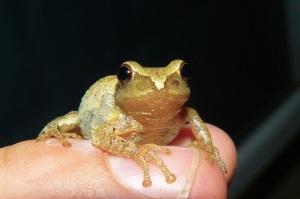
Spring Peeper perched on the finger of the photographer’s hand. Photo by Francis.

I had asked her back when I was writing about being quiet at home whether she could share some thoughts about living quietly with children. Is such a thing possible in a society where children are kept busy and engaged with sound, devices, and activities so that summer becomes a frantic schedule of athletic events, camps, sports clinics, and lessons?

As I read my friend’s responses, it struck me that her family’s life has taken the shape it has not only because she and her husband sought and found a home where they can observe and be a part of the natural world, but because they have chosen to live in ways that defy our noisy, driven culture.

This didn’t start when they moved to a rural setting. Even when they lived in a city neighborhood, they had followed the advice of a contemplative nun to look for a house with a peaceful backyard. The one they found with a natural fence of pine shrubs and trees in a neighborhood with tall trees allowed their children to explore and establish early on a habit of discovering the outdoors.

Rose

A rose from the family’s garden. Photo by Francis.

Today, each of these children has his or her favorite thing to do outside. One especially enjoys birds, another walking the dog, and still another climbing trees. “All love to observe nature,” their mother says, “whether an iridescent beetle crawling across the driveway or finding horsehair worms (that I never even knew existed) in our yard, or seeing the amazingly beautiful small parts of a flower.” And they know the location of every bird’s nest within 200 feet of their house.

Key to their enjoyment of the outdoors, the peace of their home, and their development as individuals is a measured use of technology. This family watches a favorite college football team’s televised games, occasional videos, and sometimes nature programs, but for the most part, being outside, reading a book, or playing a musical instrument is encouraged over staring into an electronic screen.

When her children were younger, my friend confesses to being tempted to buy a “false peace” with too much TV. “‘Barney’ and ‘Thomas’ were much easier than listening to kids whine about something or grouch at each other. But what I noticed is that TV just made it worse later. It put off dealing with the problems. Now, we have many days where I want to throw them all outside to eat berries and roots – where I feel like a failure as a mom. But they are each discovering their own shortcomings, they know that they have to work at them, and they have, I think, a more honest view of themselves.” Better, she says, to help them work now on their issues – be it a tendency to be bossy and judgmental, not following through on tasks, or antagonizing siblings – instead of masking them with an electronic distraction and delaying their discovery until they are adults in the midst of difficult relationships.

By being given plenty of unstructured time, the oldest boy in this family has discovered and developed an interest in art and photography, as evidenced by his photos in this post. Likewise, his younger brother has found he is good at music and writing, especially poetry. The others are still exploring, even as they begin to show the first signs of a possible aptitude or interest.

In choosing to raise her family this way, my friend was helped by the example of a mother who would stop her weeding to show her children a bird stealing yarn out of the garden to put in its nest. “She would find frog eggs in the pond and have us watch them develop. She would catch flies and put them into spider webs so we could see how they wrapped them up in their thread. She loved to discover with us.“

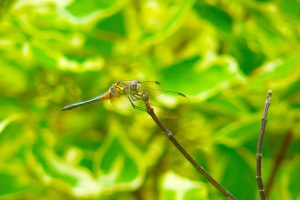
DragonflyEasternPondhawk

Eastern Pondhawk Dragonfly. Photo by Francis.

It also helps that her husband joins her in keeping Sunday as a family day, going on hikes with the kids, and planning adventures for them in their kayaks and canoes. He even wants to build a zipline on their property.

My friend once heard a philosophy teacher say, “Why have our children stopped asking questions? Is it because they are so busy that they have no time to be still and look at the clouds and wonder?”

By choosing quiet over noise, and providing time to be outside and marvel at what is there to see, my friend and her husband are fostering wonder and discovery, helping their children learn about the world around them as well as the one within.

Engaging silence

“Silence, like the sunlight, will illuminate you in God.”

These words from the late Trappist monk Thomas Merton once greeted visitors to a barn in Monroe County, Michigan, that had been set apart as a place of quiet and prayer. The barn was closed a few years ago and has since been razed, but I thought of the sign on the door recently as I was reflecting on those among us who cannot live without constant sound. In their cars, they must have the audio system playing, and at home, the TV is always on, sometimes even as they fall asleep.

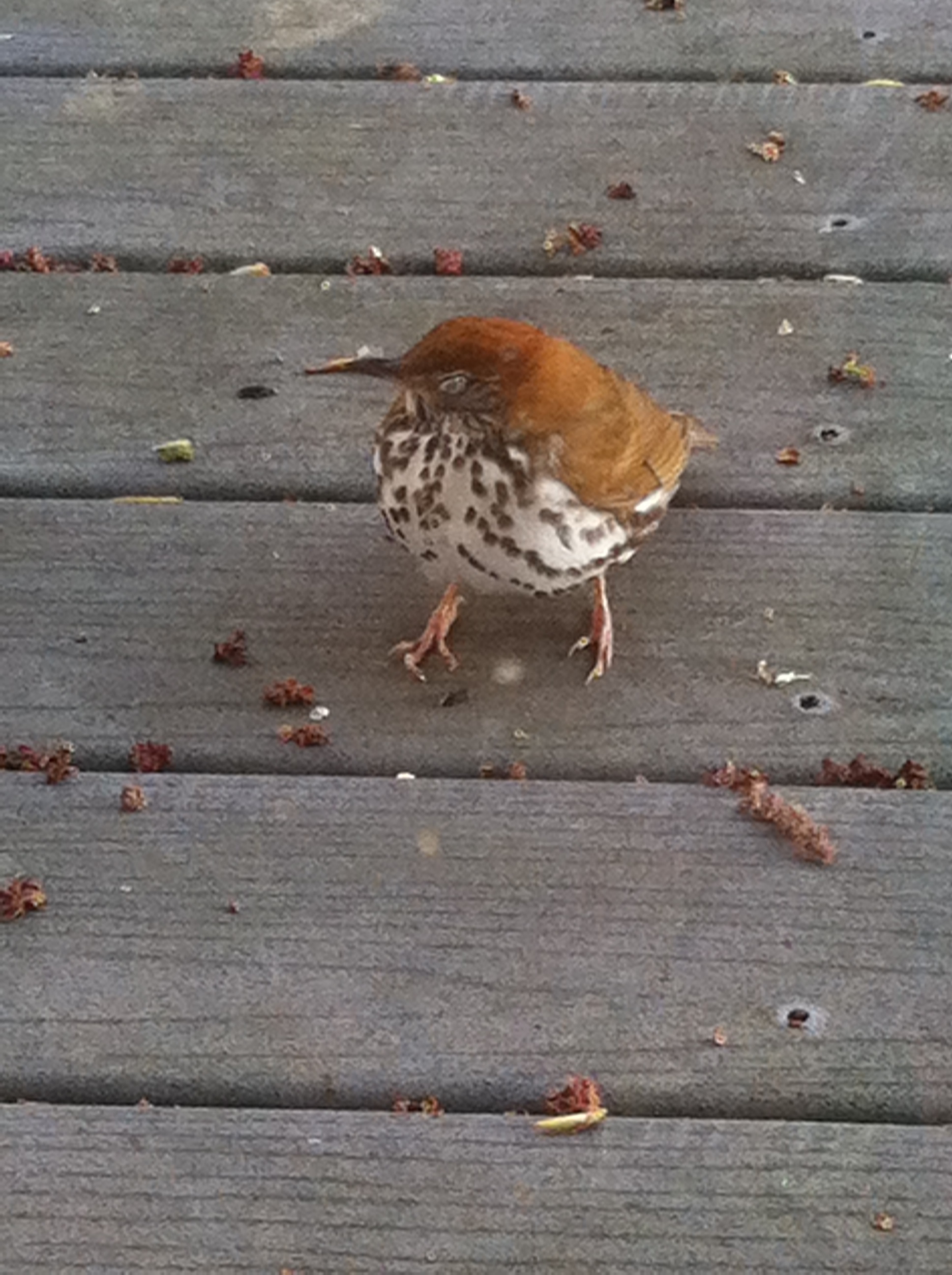
IMG_1165

Wood thrush. (This one is recovering on our deck after striking a window.)

In talking with friends who live or spend time with such people, I have pondered why this is so and, indeed, why all of us are uncomfortable with silence at times.

A writer friend tried to puzzle it out in an email as we were discussing the beginnings of this blog. She wrote, “What you’ve said reminds me of something I learned in Aristotle where he says the reason people are afraid to be alone (i.e., to be silent) is because they’re afraid of seeing who they really are. So, they fill their life with lots of distractions . . .”

Silence, as Merton suggested, does shine a light onto who and what we are, showing us things we would rather not see or consider. But perhaps it is just as true that our fondness for noise and stimulation is rooted in our fear of the seeming nothingness of silence and stillness – the vast abyss that looms before us when our tools and toys are set aside or turned off. The sheer magnitude of the quiet unsettles us and so we rush to fill it with something – anything – that can momentarily distract us and assuage our discomfort.

When blogger Kim Smith (NatureIsMyTherapy.com) wrote recently about her quest for more stillness and her struggle with distractions, she cited a piece in the Utne Reader on “The Lost Art of Doing Nothing.” In it, Christian Williams talks about “losing the ability to sit and do nothing” because he, like everyone around him, now habitually turns to a smart phone to fill down time. In urging us to “spend more time staring into space rather than into a screen,” he suggests that silence and stillness are breeding grounds for new ideas and solutions. I would add that being still is not so much a state of nothingness as a canvas ready to receive a different design or even a moment of delight. Silence is really a preparation, a cleansing, a clearing of the ground for something new or better that we will never hear or see if we constantly fill in the background with noise or stimulation. Some friends who have recently gone on silent retreats engage in this kind of purging when they agree to refrain from speaking, except to pray out loud or meet privately with a retreat leader. This discipline has a purpose: so they can hear the still, small voice of God that is often drowned out by the clamor of our lives.

The other morning, as I was waking, I heard a wood thrush singing outside. It is a sound I typically hear earlier in the spring and so I wasn’t especially listening for it, but the conditions were right: the window was open, the clock-radio was set for prime bird-singing time, and when it did go off, it was not blaring, but set to play gentle music at a low volume. I was also able to hear and enjoy this bird’s reedy song because I had made space to listen to and identify it some years ago. One spring evening, I followed the sound through the woods, eventually training my binoculars on its source and pairing the wood thrush I saw with the splendid sound I had been hearing. Had I not stilled myself and carved out some times of quiet to become an observer of birds, I would have missed this auditory treat, part of a rich feast of bird song available to anyone willing to listen and experience the enrichment it brings to life.

This is just one example, but in offering it, I mean to say that those who master silence and stillness lead lives that are anything but hollow. They may not have filled their minds, eyes, and ears with a panoply of ready stimuli that form the stuff of social chatter, but having confronted and engaged the seeming emptiness of silence and the initial discomfort it brings, they hear and see what so many miss – another layer of life that lies beyond and above the pressing business of what we call living.


The art of being in a garden

“She loved . . . tending to her plants. She was outside any chance she got.”

I don’t know the woman described in this excerpt from an obituary I happened to read this week, but as a gardener, I recognized her as a kindred spirit.

Although gardeners are as varied as any group, I suspect we all share a love for the peaceful ambience of our little plots of ground and the refuge they become when we are in them. There is something about sinking our hands into the dirt while we listen to bird song or spy a dragonfly nearby that soothes the spirit and settles our thoughts.  And so, regardless of whether our gardens are exotic or ordinary, we simply revel in being in them.

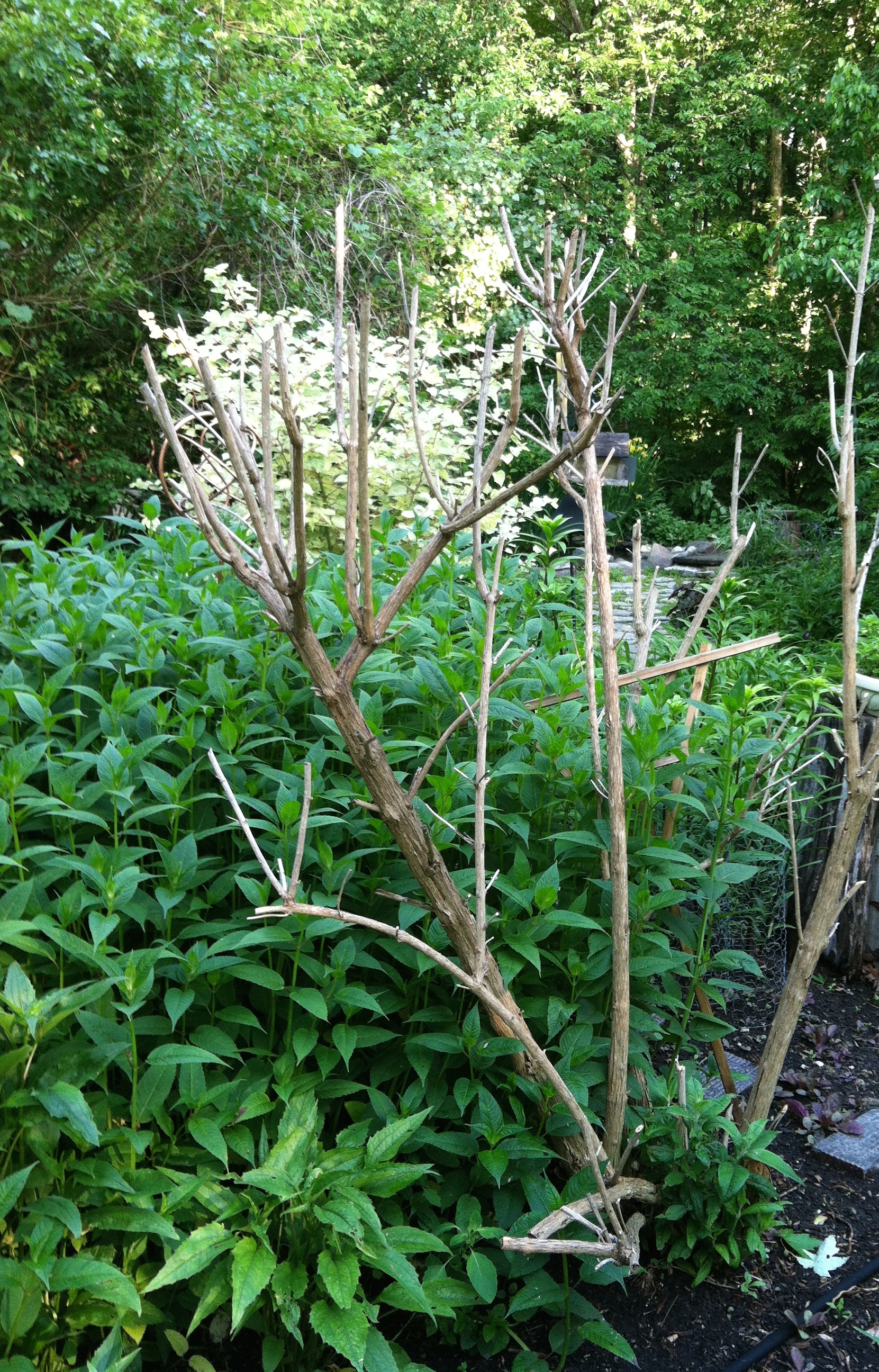
IMG_1350

Bare branches of Butterfly Bush with Bee Balm and Fallopia in background.

I have learned the value of this anew after a prolonged, brutal winter that ravaged my own green space in places, leaving it bereft of several mainstays, including two nearly decade-old bushes that previously had attracted butterflies and hummingbirds.  Initially, I felt disappointment at the loss of these faithful producers. But as I’ve worked under and around them after deciding to leave them in place for now, I’ve realized that the essence of being in a garden remains even when the landscape changes.  Much as I have grieved the absence of foliage on these old faithful producers, it hasn’t diminished the quiet beauty of being in a place teeming with life.

IMG_1371

Remains of ‘Big Silver,’ now a shelter and food source for wildlife

Further, as I considered my losses, I was reminded of the year we had to fell “Big Silver,” a grand old beloved tree that stood at one end of the garden. When it succumbed and had to be cut down lest it fall on the house, we decided to leave parts of it in place so that it now shelters all kinds of wildlife, giving the space around it a different dimension. Just so, the frames of my dead shrubs are functioning as perches in the garden for dragonflies and birds, all seen more easily because of the bare branches.

In looking past what didn’t survive, I also have seen gains. Some Siberian Irises that were transplanted two years ago bloomed beautifully this spring, as did the Brunera and Solomon’s Seal. The Elderberry bush, which was just starting to form leaf buds in March, is now lush with foliage and buds.  Daylilies given to me by a gardener friend who was dividing hers in the summer of 2012 look like they may be destined for their best year since being relocated, and the Fallopia has accomplished its annual miracle of growing into a leafy bush from the ground up after the previous year’s stems were cut away.

IMG_1357

Plants in the flagstone walk

By taking the losses with acceptance and the gains with gratitude, I also am reminding myself that, like the farmers who sow the fields around me, I’m not in charge of the growth cycle, the weather, and the seasons.  I am merely a cooperator who takes her cues from the soil and surroundings by working with both and planting what grows well here. For me, that means choosing Butterfly Weed over a showy Hibiscus when browsing the perennials at the greenhouse and allowing native Violets and Spotted Touch-Me-Not to grow here and there along with offshoots of plants from the garden that have simply appeared between the spaces of the flagstone walk.

Truly, a garden is all gift and grace. Whether I’m working in the one that has been given to me or merely looking upon it, what is most important is the sense of peace it provides and its connection to a natural world that was here before I arrived. No matter how this garden looks because of a harsh winter, it is less about achieving an ideal than about being in a place that shelters spirit and life.

The power of a quiet life

“We live in an age of noise.” Some years ago, a tall, quiet, and rather austere man spoke those words on New Year’s Day to a group of people gathered in a small inner-city church.Image

He went on to talk about the value of silence, and as he did, I pulled out pen and paper to record some of what he said. In the years since, as I have tried to find more spaces of quiet in my life, I have occasionally returned to those notes, especially after deciding to write about what I have come to call “quietkeeping.”

When I met the man who spoke that day, I was a newspaper reporter doing an article about his church. As I got to know him better in later years – and became a member of his parish – he would say in his wry way, “Judy, write me a nice obituary.” After I left my newspaper job, I regretted that I would not have that opportunity. However, when he died last week, it occurred to me that this blog would be a fitting place to honor him by writing a little about the reservoir of quiet that was his life.

At his funeral, it was said he had been a private person with few friends. Yet, as was evidenced by the attendance, many people were drawn to him, not because he was the proverbial “nice guy,” but because of something magnetic at his core – a steely resolve that made him just a little hard-headed at times and allowed him to speak truths that were not always comfortable to hear. In speaking and preaching, he was a master of brevity and economy, crafting simple, pithy sermons that sent listeners home with a thought to ponder or an action to take. He believed in conveying whatever he had to say in seven minutes. “Anything more, put it in the bulletin,” he counseled a deacon who spoke at his funeral. Still, he packed much wisdom into that short span of time and his New Year’s Day sermon on silence was a perfect illustration.

The message he spoke that day obviously came from someone who was acquainted with silence and made room for it in his life. Lamenting that we had come to a place in our culture where “even our computers have speakers,” he said we don’t appreciate what can happen in silence. He suggested taking 15 to 20 minutes a day to be silent and to listen to the voice of God – a sound he said is easily drowned out by noise.

On the day before this man’s funeral, I read words that echoed his. They were from 14th-century theologian John Tauler, who said, “When the wind howls, and the doors and windows clatter, one can hardly hear the voice of man. As to the voice of God, that fatherly, whispered, secret word, uttered in the inmost depths of your soul – if you will hear it, you must be deaf to all the roar of the world without, and hush all the voices of your own inner life.”

At the church where the man I am writing about served, a sign on the inside door asks those who enter to remain silent. The worship services there are on the quiet side with very little in the way of announcements or spoken exchanges between people – that is, until after the service ends and everyone spills outside. Because of what happens inside, however, going there is truly a respite from the madness that often marks our lives and an opportunity to focus on something bigger than ourselves.

My husband and I were drawn to this place precisely because of the quiet – and the quiet man – we found there. He is gone now, but the lessons he taught that New Year’s Day – and in his simple, uncluttered life – endure. He was able to still himself to listen to the voice of God and let it guide his thoughts, his words, his silence, and his actions. Encountering him left you wanting the peace he possessed. Thankfully, he left instructions.

The still life of a birdwatcher

blog-header-april-2014-940x198

Blackburnian Warbler. Photo by Kim Smith

The year I ventured into the world of serious birdwatching, I probably spent as much time observing the birders as the birds.

Something about the people who were able to discern the presence of a particular bird, first with the naked eye or ear and then through binoculars, fascinated me, as did the near-magical atmosphere of the wildlife area where they had flocked to seek out birds during the spring migration.

I saw serene, thoughtful countenances, felt a sense of quiet anticipation, and heard a whole new language spoken mostly in subdued tones: “Cooperative male Canada warbler with a nice necklace. Around 10 o’clock, where that branch with the clump of leaves forks. See? He just dropped down. There, to the right of that tangle.”

Like a star-struck groupie, I was drawn to these longtime avian enthusiasts who had the air of experience about them, yet would take time to help me through my early awkward efforts at birding, guiding me to my first sighting of a spectacular bird.

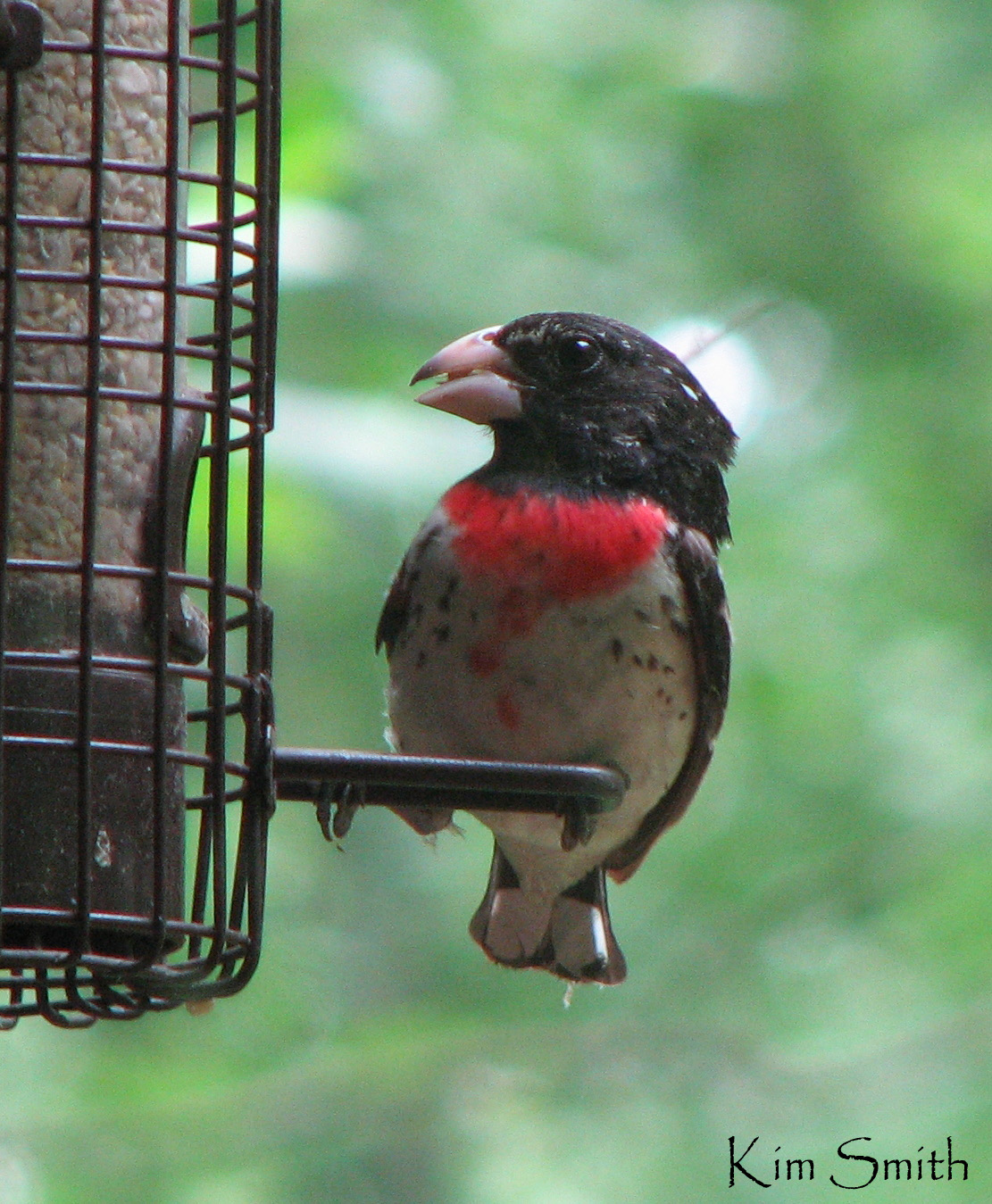
Rose-breasted Grosbeak by Kim Smith

Rose-breasted Grosbeak. Photo by Kim Smith

They won me over not with flashy personalities, but with serene and generous spirits that beckoned me to share in the knowledge they had developed over years of keen observation. Although like every other group, birders are diverse, I noticed that some of the best are quiet types who don’t have the trappings of a big personality or the gift of clever repartee. They seem to possess an inner repose and so bring to birding a receptive spirit that settles in to listen and watch, easily tuning out distractions.

From watching and interacting with these tranquil beings, I wanted to be more like them, much as a young disciple looks to a spiritual father or mother as a model. I remember especially a man with a disabling physical condition who identified a Prairie warbler for me during my first year of birding. In succeeding years, he has no longer been able to easily navigate through the clusters of birders on the trail and so has done most of his birding from a folding stool, but whenever I see him, I am assured of hearing a report of some splendid sightings. I always have the sense that he sees and hears things the rest of us miss because we have to keep moving.

Regardless of their religious beliefs, birders have confirmed what my own spiritual tradition teaches: that the stillness, quiet, and attitude of listening birders bring to their pursuit are essential if we are to hear or see anything of lasting value. As Rumer Godden writes in the book, In This House of Brede, referring to an artist who has come to the monastery to work, “It was the silence of Brede that pleased him. ‘I can hear life,’ he said.”

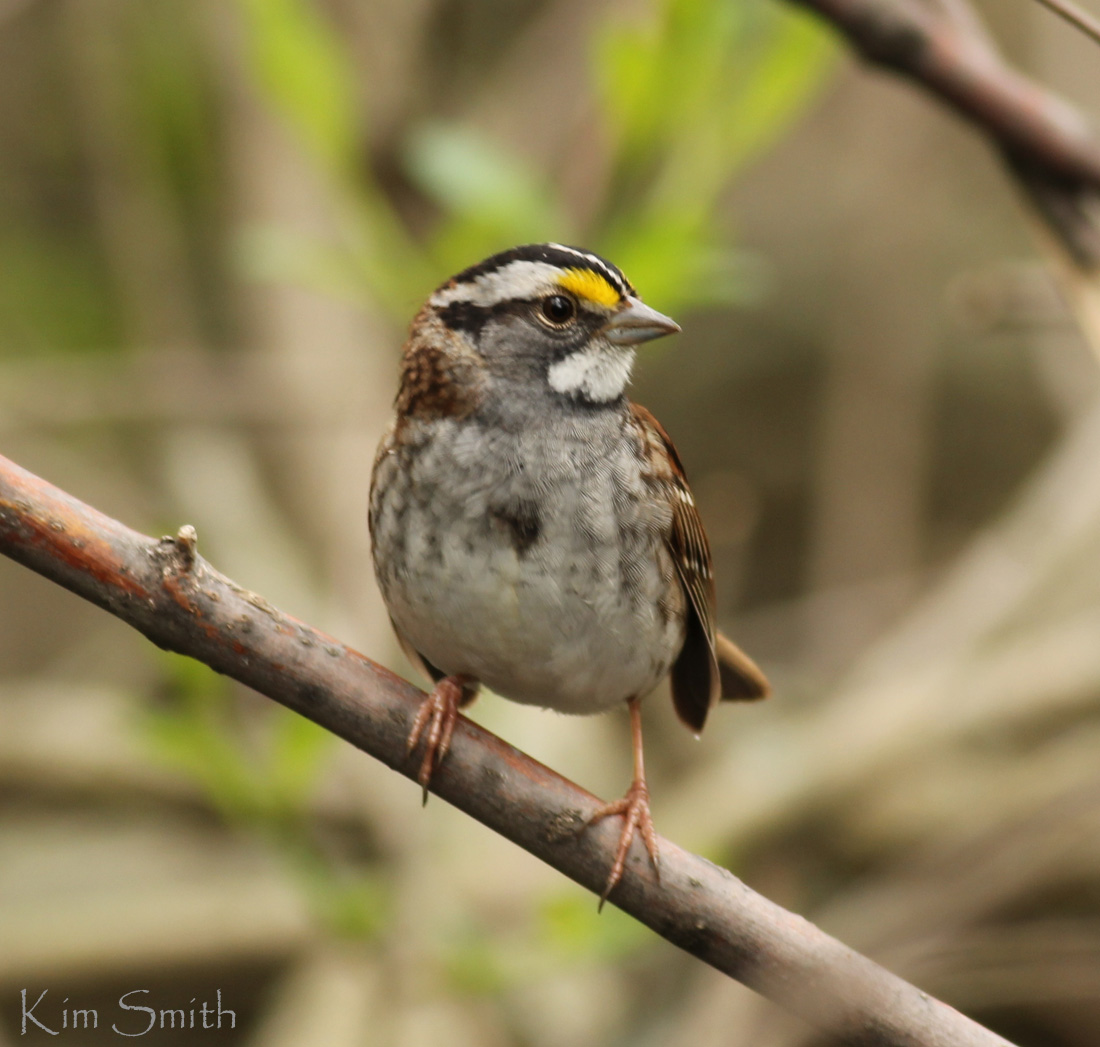
White-throated Sparrow by Kim Smith

White-throated Sparrow. Photo by Kim Smith

In a world numbed by its attachment to technology and noise, the birders I have observed and emulated hear and see life, whether they are delighting in finding a tiny Blackburnian warbler with its brilliant orange “fire throat” or an American Woodcock whose brown camo coloring allows it to blend into the woodland landscape.

I share in this richness of the bird trail when I slow down enough to listen to the simple, soothing song of the White-throated Sparrow on these spring days, notice an Eastern Phoebe patiently waiting for the movement of an insect in my garden, or spy a Rose-breasted Grosbeak on a branch outside the kitchen window.

But I reap even more when I apply the lessons of birding to my daily life: when I am willing to wait and watch for something wonderful, when I listen for the sound of a distant song, and when I am still enough to believe in the Goodness of it all.


Where the birds are: If this post has piqued your interest in birding and you can travel to northwest Ohio, known as the “warbler capital of the world,” a great once-a-year opportunity awaits you during the Biggest Week in American Birding, which begins Tuesday, May 6, and continues through May 15. Also, Kim Smith, who blogs at natureismytherapy.com and graciously provided photos for this post, will be blogging from the Biggest Week and coordinating the efforts of the event’s blog team.

Quieting seasonal stress

As the ground begins to thaw and the air takes on a hint of warmth, it is difficult to resist the impulse to plunge into activity.

Even as I look at a mostly brown garden that has only patches of foliage and a few miniature irises making a late appearance, my thoughts are turning to the work of scooping out the covering of leaves, pruning shrubs for more efficient growth, and clearing and cutting the brush that sheltered and fed the birds during the winter.Image

Already, I am getting busy in thought and deed.  It seems to be a hallmark of spring that we emerge from our winter rest by declaring that we’ve had enough of lying about and are ready for action. As a gardening friend reminds me, though, spring is also a season of stress. Lovely as it is, it brings with it a sudden awareness that there is much to do and the frazzled feeling of urgency to get on with it.

Of course, activity can be exhilarating, as well as affirming. In the U.S., at least, it is practically a national virtue, and we are expected to be busy if we are to have any significance. Even as we age, we ratchet up our activity levels lest we feel or appear “old” and unproductive.

Much as we exalt the merits of busyness, though, when taken to extremes, it has a way of disturbing the peace with its undercurrent of white noise.

When I’m overly busy and preoccupied with my list of things to do, there is a nice hum to my life, but I may miss what someone is saying in a conversation or email. Or I exude such a sense of hurriedness that there is no space for a genuine exchange or the opportunity to be truly helpful. Sometimes, I will forget or neglect a mundane but important task, and then write myself a pass because, after all, “I’m busy.” It’s as if I am happily breezing along a waterway in a speedboat, unaware that my vessel is slowly leaking oil because I’m reveling in how fast I’m going.

So before I get too immersed in the busyness of spring, I’m rethinking my normal response to this change of season. I’m working in the garden with an eye to enjoying each task and my surroundings rather than “getting it done.” I’m hoping to be a little more like the owner of a greenhouse I visited a few days ago for my first glimpse of the spring blooms. She was watering plants when I walked in, but she took time for a leisurely chat as we basked in the warmth of the sun that was pouring in that day. While we talked amid the beauty of the thriving plants she had been tending, I was struck anew by something else she has cultivated: a welcoming presence that draws people to her greenhouse as much as what is growing inside. It was a timely reminder to ease into spring, knowing that this season is as much about gazing on its beauty as getting things done.

Keeping faith when spring is late

Image Spring is here, or so the keepers of time tell us.  We have passed that notch in the calendar when light and darkness are given us in equal measure. Winter is past and we can breathe a collective sigh of relief and begin to enjoy longer days and the sight and smell of things getting about the business of growing. For now, though, that is only a hope, and what we see is not quite what we’ve been awaiting. The landscape is little more than a palette of various hues of brown. The remaining snow has lost its brilliance and is tinged with dirt. And the ground, whether covered with matted leaves or heaving up in a kind of awakening, is, well, muddy. It would be tempting, after the long wait for spring, to sink into disappointment, especially when the weather warms briefly and then turns cold, or brings us more snow. Yet, a late-arriving spring like this one has something to offer and, if we’re smart, we will befriend it and let it walk us slowly into the richness of the season. Now is a time of preparation for what is to come, to gaze on the stark canvas around us before it begins to burst into color and growth. After all, when it does, life will get very busy, not only in the natural world, but in our lives. Activity will ramp up as schedules swell with graduations, weddings, and ball games. Homeowners will frantically pull out coolers and grills, uncover deck furniture, and fuel lawnmowers for the first of many cuts of the season. Gardeners will feel an urgency to ready their beds and plant even as the local greenhouses warn them to heed the frost-free date. Wildflower and bird enthusiasts, knowing they have a small window to see Dutchman’s Breeches and migrating warblers, will rush to converge on wildlife areas armed with guidebooks and cameras.Image So, much as I’m longing for sun, warmth, and the sight of a Swamp Buttercup or a Black-throated Blue warbler, I’m taking a pause on these chilly, doesn’t-feel-like-spring-yet days. I’m contemplating the mud, knowing it could be nesting mortar for Eastern Phoebes if they choose to stay again to raise a family. I’m watching the squirrels stuff their mouths with leaves and scurry up trees to prepare beds for new broods. I’m enjoying the cacophony of chatter from a flock of blackbirds or the song of a single robin as the sun amazes me with yet another spectacular rising or setting. I’m taking a closer look at what appears to be nothing and am noticing the winter feathers of the male Goldfinches start to turn yellow, buds on the branches of an Elderberry bush, and the first leaves of Bee Balm at the base of the brown stalks from last year’s growth. In the belief that anticipation is often the best part of a vacation or a happy event, I’m drinking in this time and appreciating it in its somewhat awkward adolescent phase because I know without seeing that it holds the promise of something quite wonderful that is yet to come.

Waiting for spring

Image

Sometime around mid-February, those of us who live where seasonal change is felt most keenly start the long wait for spring.

With that season of promise nearly upon us as I write, the signs of its approach seem sparse. An east wind is blowing off a frozen lake and temperatures returned to the teens overnight. Further defying the onset of warmer weather are the stubbornly intact patches of snow that, though beginning to diminish, cling to our landscape.

Absorbed in this state of waiting, many of us are edgy, irritable, and anxious, even as we try to remind ourselves that spring must come eventually. We glance outside and then look at the calendar, counting the days until the equinox. Still bundled in our winter coats and scarves, we gaze longingly at spring merchandise in stores. We rejoice and celebrate the occasional mild day, even as our hopes are dashed by another snowstorm or cold front.

We are waiting, and maybe not so well, especially when what we see and feel doesn’t fit our desire to shed our winter layers and bask in warmth again. Instead of getting locked in frustration, though, I am starting to notice that if I can quiet myself just a little,  I can see and hear signs that something in the earth has shifted, signaling a new season is on its way.

After all, although there is still snow on the ground, much of what fell during a March storm that blanketed our area last week has already started to disappear, revealing – could it be? – grass.  On closer inspection, I notice the tips of daffodil foliage emerging. Near a pond frozen over and covered with snow, I am able to see more and more of a log that has been our snow-depth gauge all winter. And the male cardinals who have brightened wintry days with their brilliant red feathers have broken their silence, moved to resume singing by what they know to be coming.

A fellow writer who senses this change says she is feeling the intensity of the sun on her walks in a way she did not in January. Her spirits have taken flight at the sight of returning red-winged blackbirds, robins, and bluebirds. “You know that winter has lost its grip and is on the way out,” she writes, “no matter how much it tries to make us feel that it isn’t.”

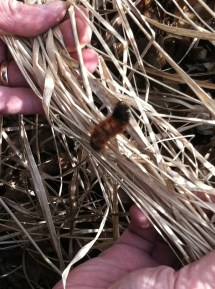
The day before our latest snowstorm, I found a woolly bear caterpillar on a lane between two open fields. Knowing the storm was coming, I tucked this little herald of spring into a brushy area inside the woods not only in hopes it would survive, but as a pledge of faith in the coming season of new life.

Waiting can be a time of watching and listening and delighting in what we see and hear, if only we will open ourselves to it. For me, these days of anticipation are ones in which I am reminding myself to spend time outside whenever I can, even if the temperature and wind speed are not quite ideal, and to keep my eyes and ears attuned to the harbingers of spring.