What lies beneath the leaves

The works of the Lord are sublime; those who delight in them are right to fix their eyes on them. ~ Psalm 111:2

For all the years I have had milkweed growing in my garden, I had only ever seen the Monarch caterpillars that feed on its leaves or the beautiful orange-and-black butterflies that the larvae become. 

The in-between stage when the black-and-white-and-yellow caterpillars attach themselves to a leaf or stem, later shedding their skin for a chrysalis from which the butterfly emerges, had eluded me.  

A Monarch caterpillar on a Common Milkweed.

Always, it seemed, the caterpillars would disappear to begin the pupa stage and complete their reproductive cycle. But late in August of last year, my habit of looking into the garden to see what delights might be worth fixing my eyes on led me to a Monarch caterpillar in the “J” position. This meant it had spun a silk pad and hooked its tail end into it before dropping into the shape of a “J.” Later, it would shed its skin to reveal a chrysalis. This caterpillar had chosen the branch of a Jewelweed – not exactly the most sturdy plant in my garden – and, sure enough, when I looked again a few hours later, an apple-green chrysalis was hanging from the branch. 
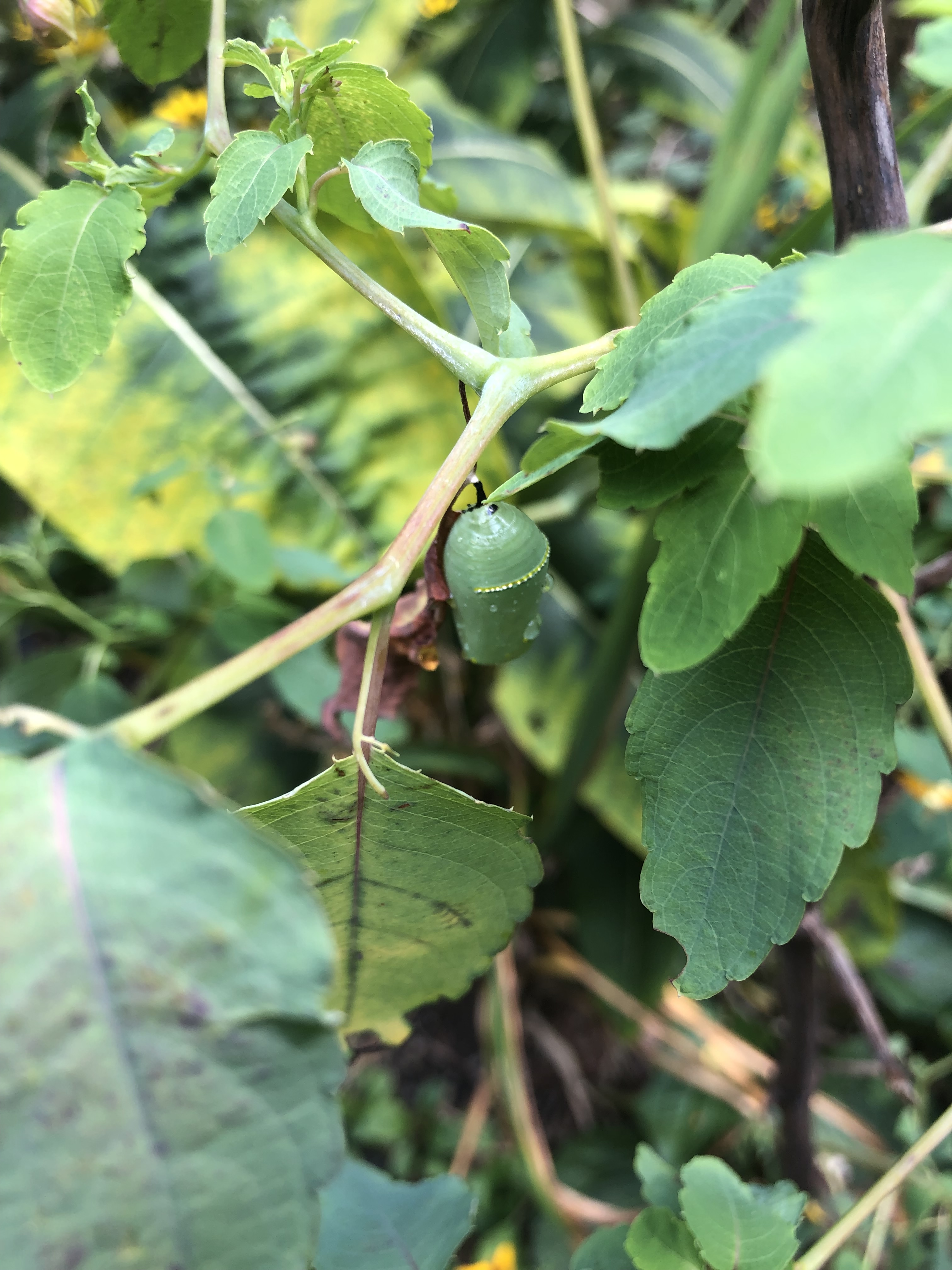
A Monarch’s chrysalis hanging seemingly precariously from a Jewelweed branch.

Of course, I immediately began checking the Jewelweed whenever I was outside, making sure the chrysalis was still there and eager to observe any changes that would indicate the life cycle was progressing. When a storm passed through, I even propped up the Jewelweed with a branch to make sure the chrysalis would have sufficient support. My frequent inspections were rewarded when on Day 13, I noticed the chrysalis had started to turn translucent, revealing the folded wings of butterfly inside. By the next day, the chrysalis appeared to be even darker, and when next I checked, a butterfly had emerged and was clinging to the empty clear casing. What a delight it was to see it flitting about the garden and joining the other Monarchs that were around. 
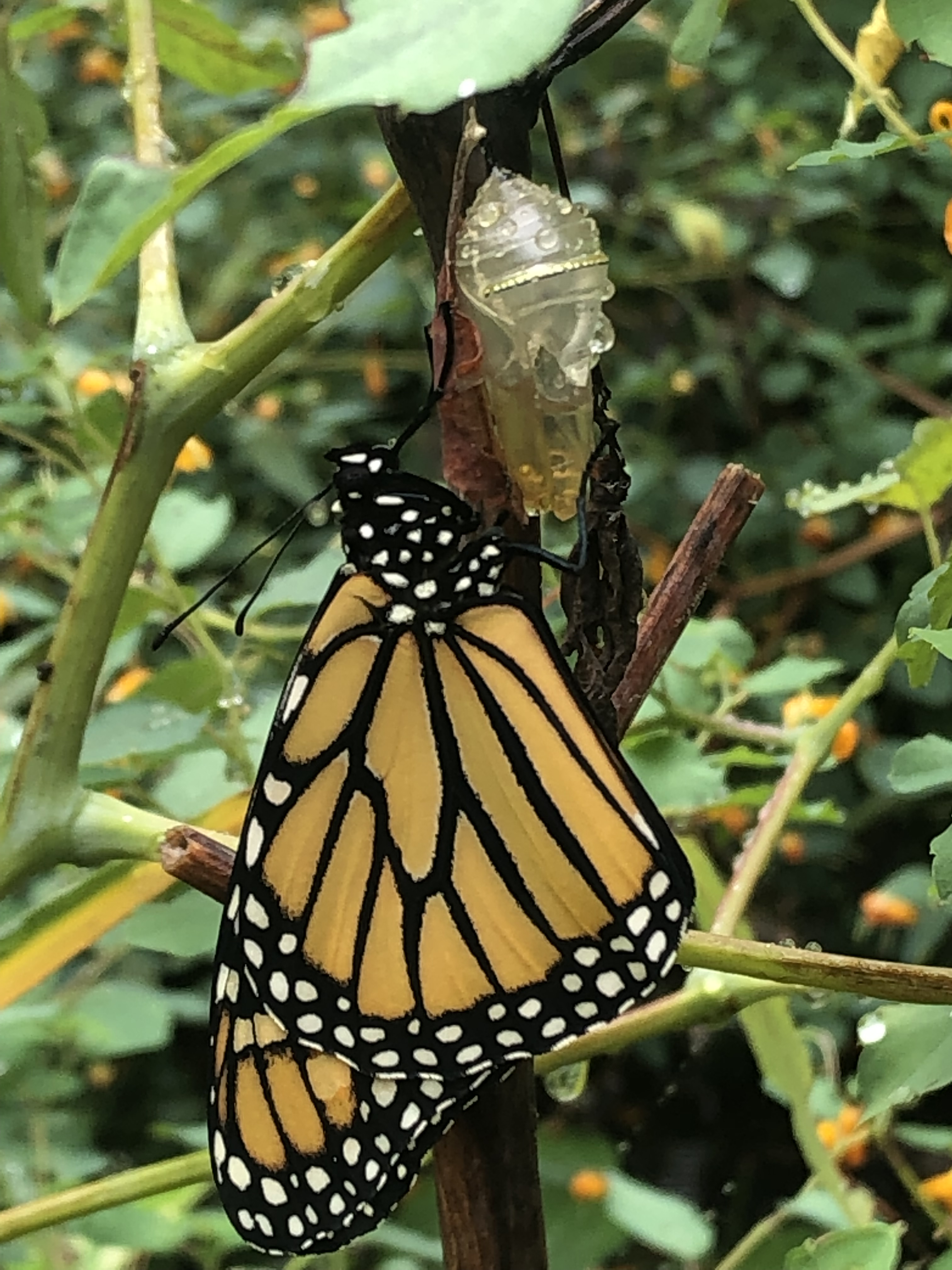
A Monarch butterfly, fresh from its now-empty chrysalis.

Then, two days later, on a morning inspection of the garden, I saw another Monarch caterpillar in the “J” position, this one under a milkweed leaf. By 3 o’clock that afternoon, a chrysalis was in its place. Happily, I resumed my frequent inspections and by Day 15, noticed the chrysalis had started to turn translucent. It wasn’t until Day 19, however, that it had darkened.
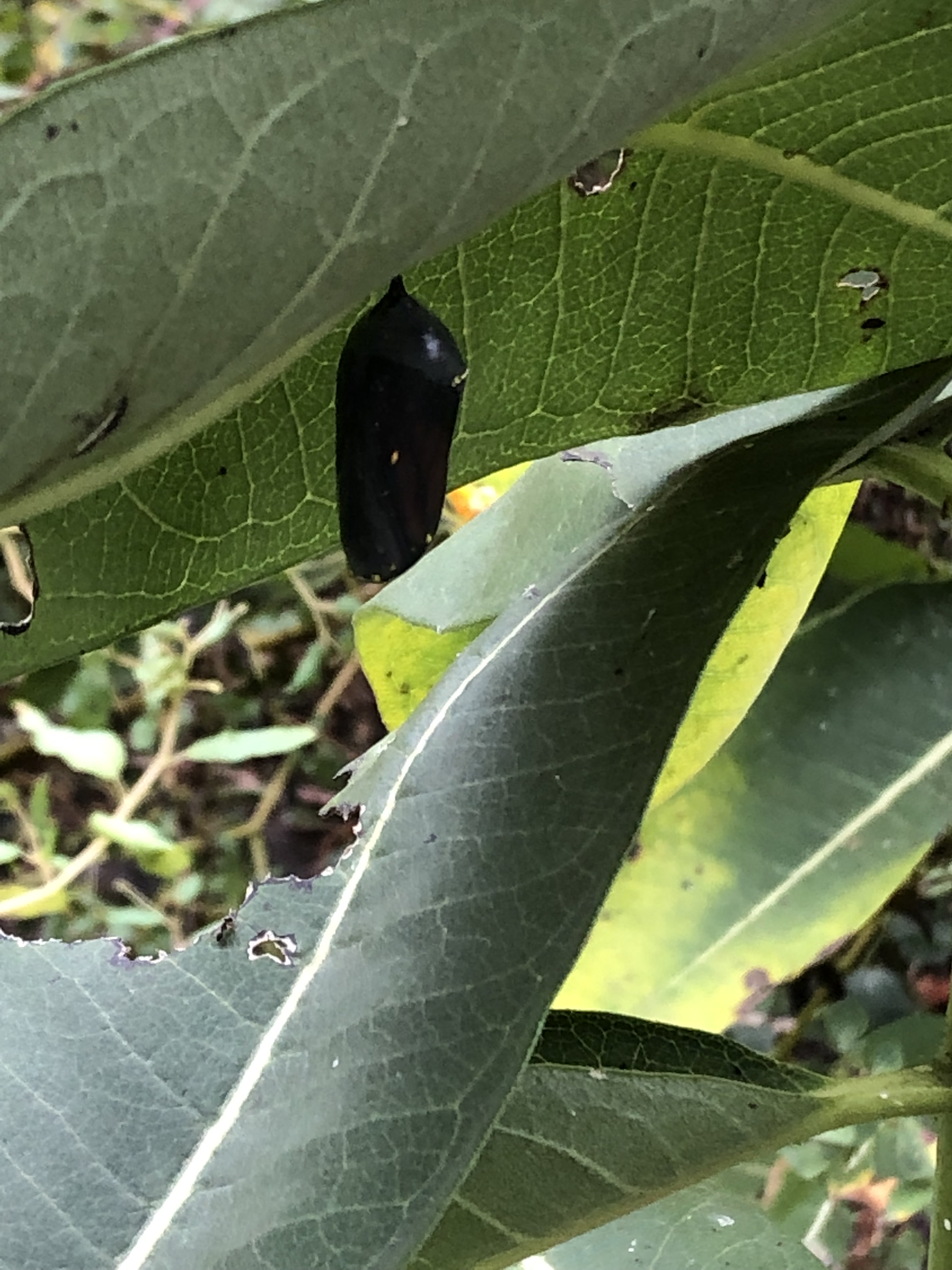
The chrysalis appears black just before the butterfly is ready to emerge.

On Day 20, I had to leave the house early in the morning and by the time I returned around 9, the butterfly was out of the chrysalis, but still clinging to it, its wings looking somewhat crinkled. Within 30 minutes or so, the wings had straightened and the butterfly was moving and cleaving to a leaf. I later saw it had flown to a Fallopia near the milkweed. It was still there the next morning, but after that, I didn’t see it again. 

The second Monarch rests on a Fallopia after leaving the chrysalis.

That these sightings were a gift was driven home to me this year when, despite faithful inspections of my garden, I saw only Monarch butterflies, a few caterpillars (none in the “J” position), and one empty chrysalis on a Nasturtium, a plant I had checked daily, but never thought to inspect more thoroughly for such a find.

A surprise late-season find: an empty chrysalis in a potted Nasturtium.

Nonetheless, I took in many other enchanting sights: bees poking their heads and sometimes their whole bodies into Jewelweed blooms, wasps and bees on Nodding Onion blossoms, two other Monarch butterflies I discovered trapped in webbing and was able to free (one with the help of my husband) and then watch fly away, and Black Swallowtail caterpillars feasting on parsley before they crawled off to complete their own reproductive cycle.

A Black Swallowtail caterpillar feasting on the garden parsley.

And so, even as the landscape of the garden changes with the onset of fall and winter, I will remember these precious finds and continue to delight in what I see outside — for the works of the divine hand in any season are truly sublime and, as the psalmist says, it is right to fix our eyes on them.

In good company

“Nature does nothing in vain.” – Thomas Aquinas

It is a welcome visitor to our little woodland patch who doesn’t call wildflowers weeds and sees beauty in brush piles.

IMG_2439

One of several brush piles that shelter birds and other wildlife.

When such a person stops by as one did recently, I smile in silent gratitude for his or her appreciation of a setting that is friendly to birds and other living things, even though it lacks the carefully cultivated, meticulously planned look of the suburban gardens I so admire.

For years, after looking at more orderly yards and gardens, I would return home with tinges of regret that my place paled in comparison to the visions of manicured loveliness I had just seen

But mostly now, those feelings are infrequent and easily forgotten when I hear a Wood Thrush singing in the spring or watch bats swooping overhead on a summer evening. Even in the fall, with leaves tumbling down as a reminder that winter will soon set in, there are delights to savor in migrating birds and the restful sounds of the earth settling down at the end of a busy growing season.

Each day, I am reminded that much of what we enjoy was here long before my husband and I began preparing to live in this spot nearly 14 years ago. From the beginning, we saw ourselves as interlopers more than conquerors and were determined to minimize our intrusion as much as possible.

Still, on the November day we ventured in, carrying colored string and spray paint to mark trees that would have to be felled, I still remember feeling anxious and not a little sad. Even though we were moderate in our choices for cutting – probably too much so for the sake of what would be built later – I felt like an invader.

Pictures from a week later when the big machines arrived show me smiling. I suppose by then, I had resigned myself to the idea of what we were doing. I’d like to think remembering that sense of incursion, though, kept us both in check as we began to develop the site by adding a small barn, house, and trails through the woods. Always, we kept in mind what had been here when we arrived, a pattern that has continued to this day.

P1040334

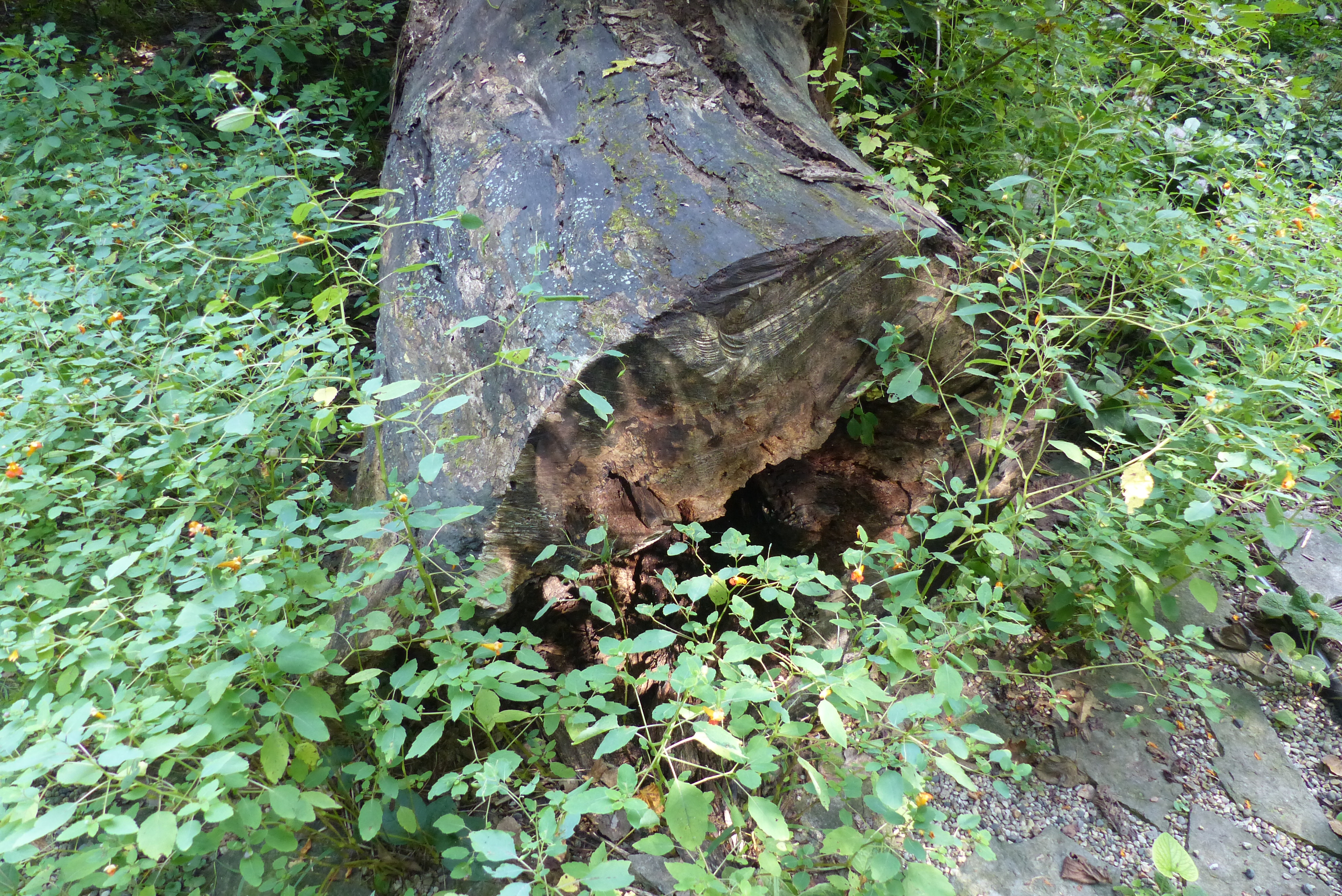
Jewelweed allowed to grow around a fallen log.

Even as we occasionally fall victim to the prolific poison ivy around us, swat at mosquitoes, and encounter the digging habits of chipmunks and squirrels, we have resisted most interventions that would eliminate what some might consider nuisances. Our brush piles, built up with fallen tree limbs and providing shelter for wildlife, are just one testament to this. Another is our choice to relocate piles of fallen leaves rather than burn or bag them as refuse.

Elsewhere, as I make an early spring effort to pull innumerable starts of native Jewelweed out of some areas, I let them grow in other spots, remembering that the hummingbirds will be enjoying nectar from their orange flowers in late summer.

IMG_2434

This sprig of Joe Pye weed popped up late in the summer between some stones.

When I notice foliage being gnawed by who-knows-what insect, I take some comfort in thinking of the culprit as food for a bird, frog, or toad, satisfied that I haven’t poisoned or repelled an avian or amphibian friend with an arsenal of gardening chemicals. Likewise, milkweed, the bane of our farmer friends, is allowed some space because it is a host plant for the Monarch butterfly.

And when I find salvia, coneflowers, and Joe Pye weed growing in cracks between the flagstone and popping up in places I know I didn’t plant them, I think fondly of the birds who are most likely responsible for adding such lovely, random diversity – and more food sources – to our landscape. It is good to know, too, as our recent visitor reminded me, that birders and others share our passion for an environment that is friendly to living things besides humans.

Most importantly, though, I cherish the serenity that comes from living in harmony and partnership with the creatures and plants of a place that predates me and from recognizing and cooperating with its great design in the mind of the One who conceived it.