What lies beneath the leaves

The works of the Lord are sublime; those who delight in them are right to fix their eyes on them. ~ Psalm 111:2

For all the years I have had milkweed growing in my garden, I had only ever seen the Monarch caterpillars that feed on its leaves or the beautiful orange-and-black butterflies that the larvae become. 

The in-between stage when the black-and-white-and-yellow caterpillars attach themselves to a leaf or stem, later shedding their skin for a chrysalis from which the butterfly emerges, had eluded me.  

A Monarch caterpillar on a Common Milkweed.

Always, it seemed, the caterpillars would disappear to begin the pupa stage and complete their reproductive cycle. But late in August of last year, my habit of looking into the garden to see what delights might be worth fixing my eyes on led me to a Monarch caterpillar in the “J” position. This meant it had spun a silk pad and hooked its tail end into it before dropping into the shape of a “J.” Later, it would shed its skin to reveal a chrysalis. This caterpillar had chosen the branch of a Jewelweed – not exactly the most sturdy plant in my garden – and, sure enough, when I looked again a few hours later, an apple-green chrysalis was hanging from the branch. 
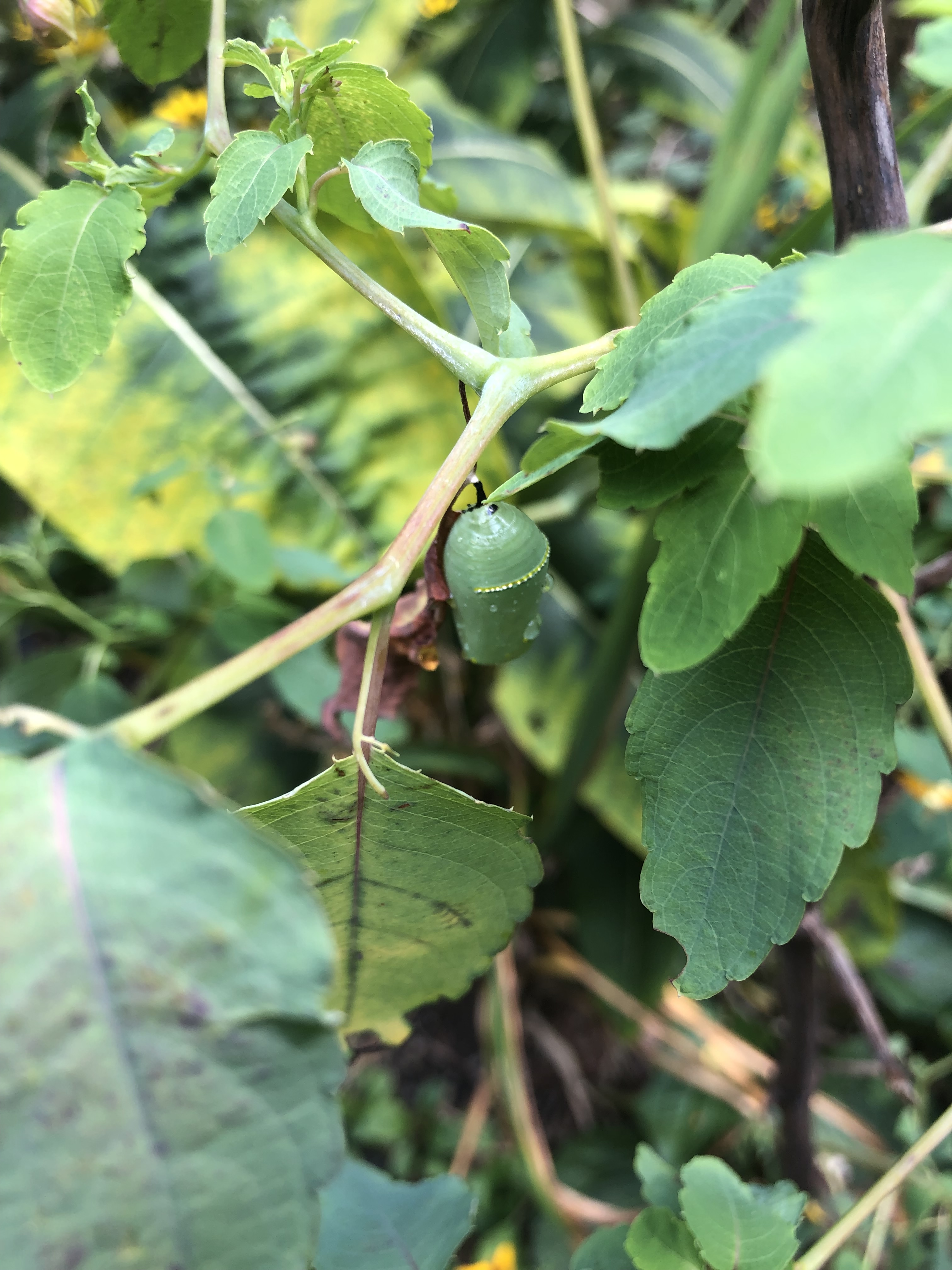
A Monarch’s chrysalis hanging seemingly precariously from a Jewelweed branch.

Of course, I immediately began checking the Jewelweed whenever I was outside, making sure the chrysalis was still there and eager to observe any changes that would indicate the life cycle was progressing. When a storm passed through, I even propped up the Jewelweed with a branch to make sure the chrysalis would have sufficient support. My frequent inspections were rewarded when on Day 13, I noticed the chrysalis had started to turn translucent, revealing the folded wings of butterfly inside. By the next day, the chrysalis appeared to be even darker, and when next I checked, a butterfly had emerged and was clinging to the empty clear casing. What a delight it was to see it flitting about the garden and joining the other Monarchs that were around. 
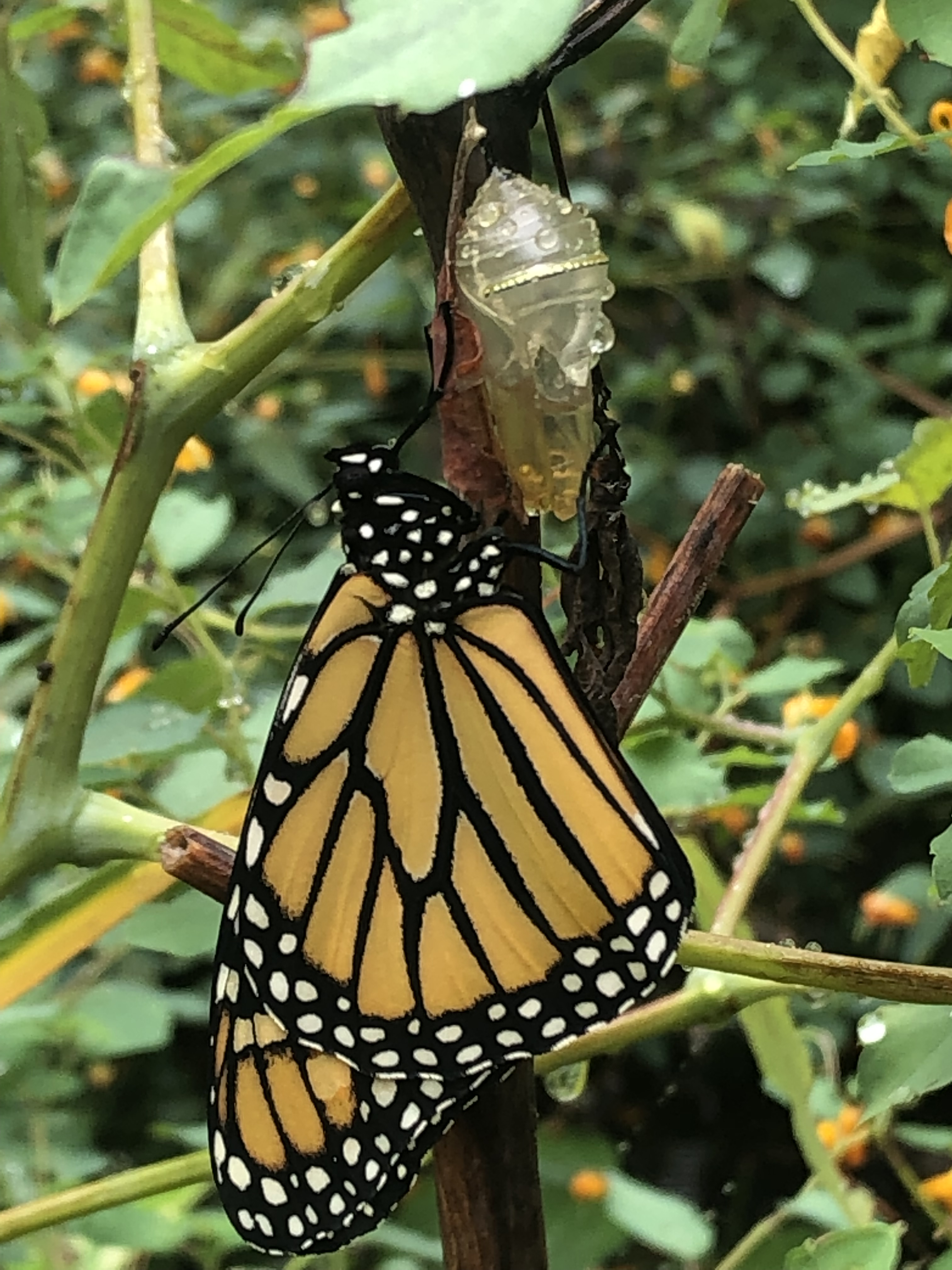
A Monarch butterfly, fresh from its now-empty chrysalis.

Then, two days later, on a morning inspection of the garden, I saw another Monarch caterpillar in the “J” position, this one under a milkweed leaf. By 3 o’clock that afternoon, a chrysalis was in its place. Happily, I resumed my frequent inspections and by Day 15, noticed the chrysalis had started to turn translucent. It wasn’t until Day 19, however, that it had darkened.
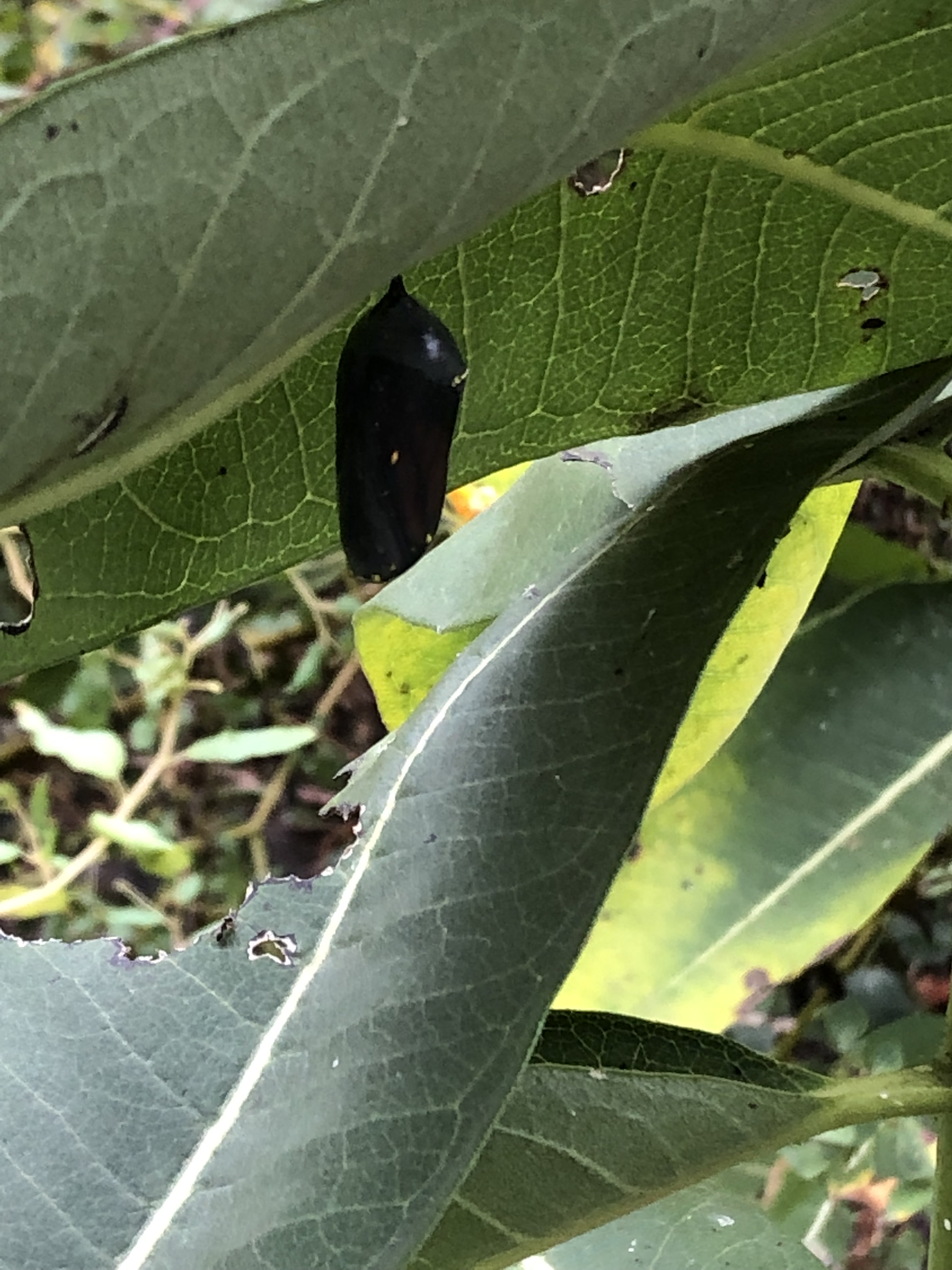
The chrysalis appears black just before the butterfly is ready to emerge.

On Day 20, I had to leave the house early in the morning and by the time I returned around 9, the butterfly was out of the chrysalis, but still clinging to it, its wings looking somewhat crinkled. Within 30 minutes or so, the wings had straightened and the butterfly was moving and cleaving to a leaf. I later saw it had flown to a Fallopia near the milkweed. It was still there the next morning, but after that, I didn’t see it again. 

The second Monarch rests on a Fallopia after leaving the chrysalis.

That these sightings were a gift was driven home to me this year when, despite faithful inspections of my garden, I saw only Monarch butterflies, a few caterpillars (none in the “J” position), and one empty chrysalis on a Nasturtium, a plant I had checked daily, but never thought to inspect more thoroughly for such a find.

A surprise late-season find: an empty chrysalis in a potted Nasturtium.

Nonetheless, I took in many other enchanting sights: bees poking their heads and sometimes their whole bodies into Jewelweed blooms, wasps and bees on Nodding Onion blossoms, two other Monarch butterflies I discovered trapped in webbing and was able to free (one with the help of my husband) and then watch fly away, and Black Swallowtail caterpillars feasting on parsley before they crawled off to complete their own reproductive cycle.

A Black Swallowtail caterpillar feasting on the garden parsley.

And so, even as the landscape of the garden changes with the onset of fall and winter, I will remember these precious finds and continue to delight in what I see outside — for the works of the divine hand in any season are truly sublime and, as the psalmist says, it is right to fix our eyes on them.

Re-opening ‘One Thousand Gifts’

Sometimes, a book that comes my way doesn’t quite resonate at the time I open it and so I set it aside for another day – or month or year. One of those “another days” recently dawned for me when I revisited Ann Voskamp’s One Thousand Gifts, a book chronicling the author’s journey out of darkness and into the light of gratitude.

When Gifts first was suggested by one of the women in a book group I was part of, I responded to it with a slight edge. After starting in, I went on to only skim the pages, grabbing a few nuggets here and there – enough, I thought, to participate in a book discussion. I couldn’t argue with the book’s premise of always looking for ways to give thanks, but Voskamp’s raw descriptions of the pain she had known and witnessed in others grated on me. For one, she had seen and lived the aftermath of her little sister being struck by a pickup truck: the blood, the lifeless body, and most of all the pain of her parents. All of it colored the rest of her days, even after she sought and found some solace in her Christian faith. I had witnessed a similar scene as a 9-year-old when my father was hit by a car the day before Christmas Eve. Although unlike Voskamp’s sister, he survived after a long recovery, the experience forever altered my child’s world and outlook, affecting me for years to come, especially at Christmas. I really wasn’t interested in immersing myself in that pain again through Voskamp’s lenses. Still, her idea of giving thanks seemed a good one and I suppose I have always tried since then to enumerate that for which I am grateful. It’s a healthy habit, after all – sort of like exercising. Not especially fun, but the right thing to do, and with the hope of benefit over the long term. 

So, when I received Voskamp’s book and a companion devotional as a birthday gift shortly after the book-group read, I expressed sincere gratitude because the books were lovely, and I sensed they held within them some future treasure to be unearthed. I left them on my desk, occasionally glancing at them and yet never feeling impelled to pick them up or give them away. 

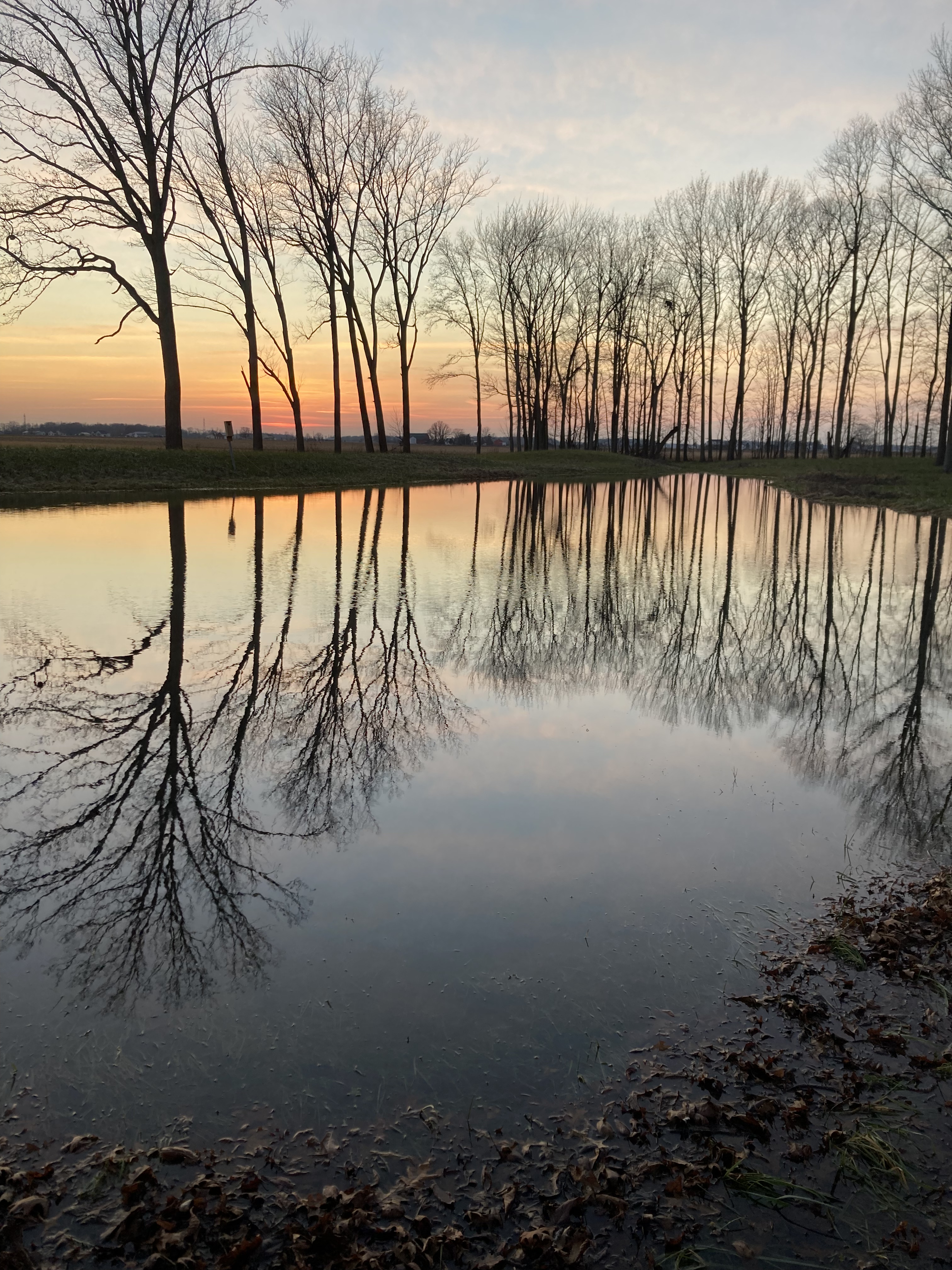
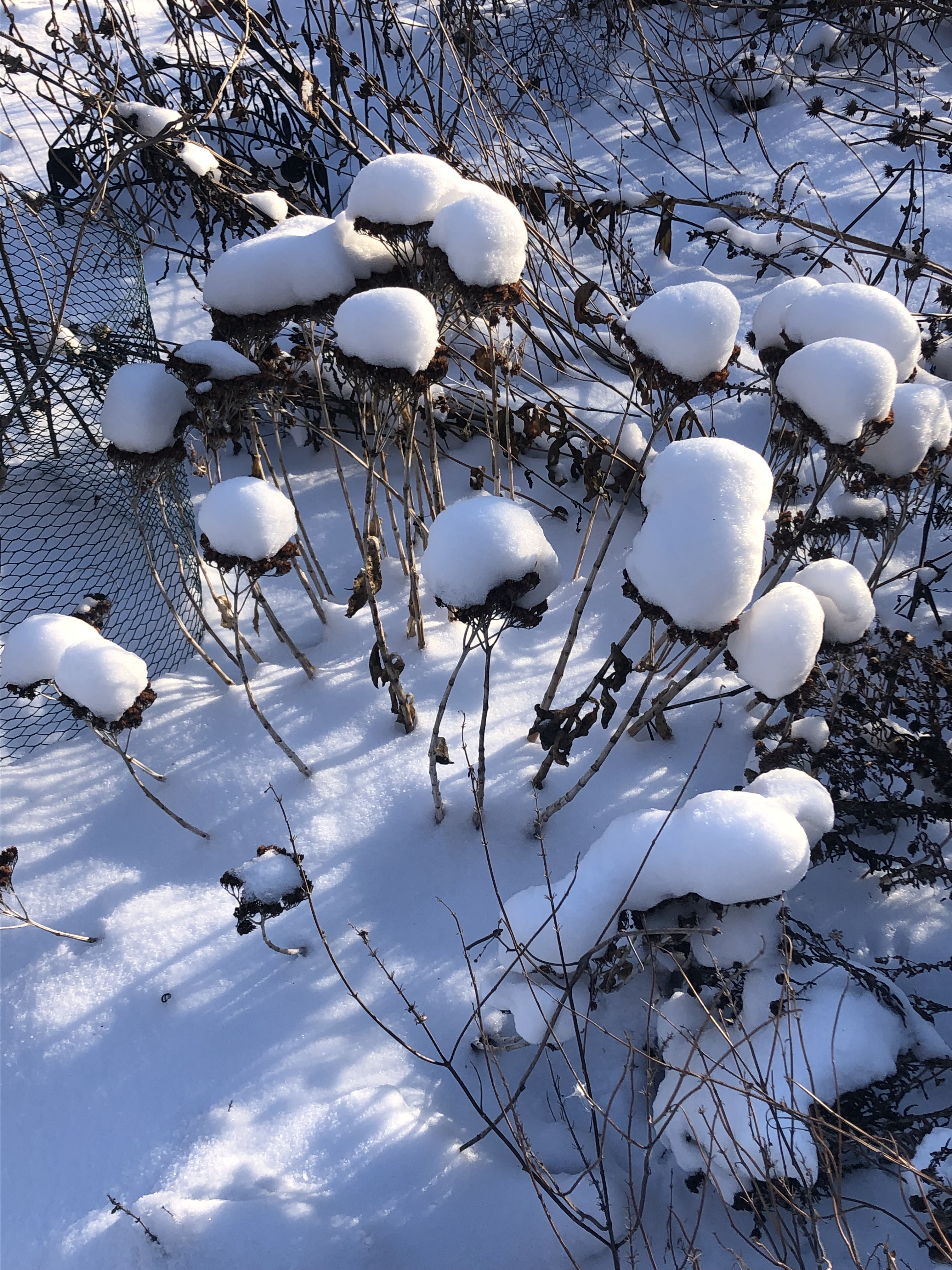
Now, in the midst of a dreary winter that has been far more frigid than recent ones, some sickness in our house, and the global stress that continues to strain all of our lives, I happened to notice those two books again. This time, I picked them up and took them downstairs to my reading chair. Although some of the content was familiar from my earlier perusal, I read with new eyes, likely absorbing Voskamp’s meaning for the first time. And as many of her readers have done before, I’ve begun my own list of 1,000 gifts. I’m not very far along, but I’m learning, as she did, to react to what happens with gratitude, naming the gifts of each day. Milkweed fluff blowing in the wind. Melting water forming ice marbles on the ground. Decaying tree stumps in the woods – nature’s sculpture. Bare trees casting their lacey pattern on the surface of a pond. Unexpected sunshine on a cloudy day. Fall’s floral remnants in the garden transformed into snowy puffs. And then those more difficult thanksgivings: the new vision and recalibration spawned by a time of trial, a neighbor’s illness bringing renewed appreciation of her presence in our lives, a nugget of awareness in the midst of difficulty that I may be contributing to my own misery. 

By continually turning her mind to thankfulness – Voskamp calls it Eucharisteo, Greek for “give thanks” – the writer of One Thousand Gifts found a new way of living and looking at life. Not that this is easy. She acknowledges that it is hard work to count even – and especially – the ugly as grace, transfiguring it into beauty with thanks. As Voskamp tells a sullen teen son, “We don’t have to change what we see. Only the way we see.” And this, she knows, is a discipline that requires practice.

Before she began her list, Voskamp knew well the biblical admonition to give thanks in all things (I Thessalonians 5:13). But she discovered there is a difference between a blanket thanks and one that lasers in on specific gifts. So she started small by learning to give thanks for one little thing, and watched the moments add up. As she did her perspective began to change. 

I’m starting small, too, and have a long way to go. But I appreciate Voskamp’s directions. And, as someone whose temperament tends more toward the melancholic than the sanguine, I like that she draws a distinction between what she is proposing and what we call being a Pollyanna. As she tells the brooding teen son, “You can’t positive-think your way out of negative feelings.”

In other words, you can’t just gloss over or ignore the darkness and cheerfully move on, as those of naturally sunny temperament seem able to do. Instead, if I’ve got this right, it’s about facing the darkness, looking into it and maybe even staring it down as we adjust our vision to find with inner eyes the glimmer of light in the shadows. 

As Voskamp writes so beautifully, “Faith is the seeing eyes that find the gauze to heaven torn through; that, slow to witness the silent weight, feel the gold glory bar heavy in palm, no matter the outer appearance.”